.png)

Extreme Sports and Concussion
A functional neurology framework for assessing concussion and whiplash in extreme sport athletes
Learn to assess concussion and sensory integration failure in extreme sport athletes using low-tech, high-yield functional neurology tools.
$
$
(
$
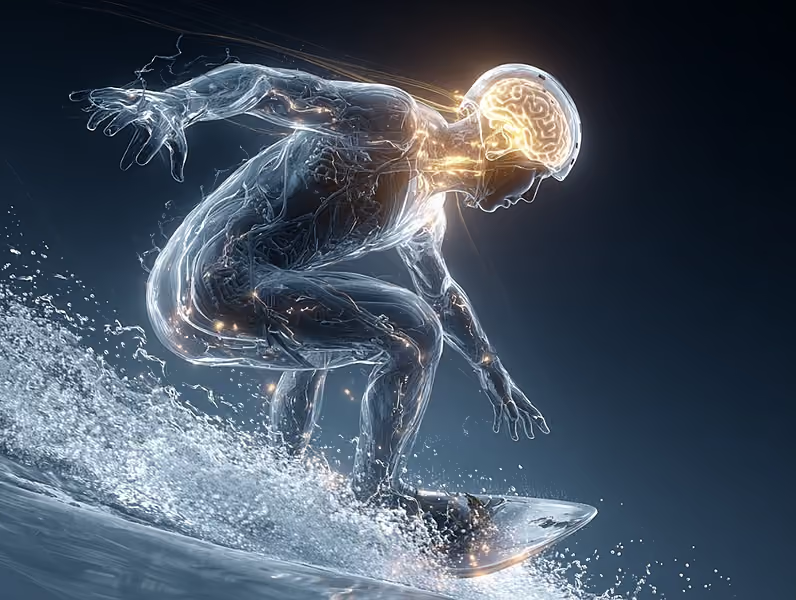
Course Description
Extreme sport athletes operate at the intersection of speed, sensory precision, and neurological demand. When concussion or whiplash disrupts that integration, the consequences extend far beyond the fall. Yet most clinical frameworks were not built with these athletes in mind.
This one-hour course taught by chiropractor and functional neurologist Haakon Andresen examines concussion and whiplash mechanics in board sports, with a focus on how gravito-inertial acceleration processing, vestibulo-ocular function, and proprioceptive integration break down after injury. Clinicians gain practical, low-technology assessment strategies including VOMS, balance error scoring, ocular tilt reaction, and subjective visual vertical testing to identify dysfunction and inform return-to-sport decisions with precision.
What you’ll learn:
- Identify concussion and whiplash mechanisms specific to extreme and board sport athletes
- Apply gravito-inertial acceleration theory to athlete balance and orientation assessment
- Perform bedside VOMS and balance error scoring in high-demand sport populations
- Evaluate ocular tilt reaction and subjective visual vertical in concussed athletes
- Explain how sensory integration failure contributes to re-injury risk in board sports
More About This Course
Extreme sports exist at the edge of human neurological capacity. Athletes in disciplines like wakeboarding, snowboarding, and freestyle action sports depend on the seamless integration of visual tracking, vestibular orientation, and proprioceptive feedback to execute high-speed, off-axis movements in unpredictable environments. When concussion or repetitive subconcussive loading disrupts that sensorimotor architecture, the deficits are rarely obvious at first glance. For clinicians who understand functional neurology, however, the signs are there to find if you know where and how to look.
This course gives clinicians a structured, neurologically grounded lens for evaluating extreme sport athletes following concussion or whiplash-type injury. Taught by Norwegian chiropractor and chiropractic neurologist Haakon Andresen, the course moves from injury biomechanics through sensory integration theory to practical bedside assessment, covering gravito-inertial acceleration vector processing, vestibulo-ocular motor screening, balance error scoring, ocular tilt reaction evaluation, and subjective visual vertical testing. The approach is deliberately low-technology and clinically transferable, designed to expand what clinicians can detect and act on, not just in a fully equipped facility but at any point of care.
This course is well suited for chiropractors, physical therapists, sports medicine clinicians, and other licensed healthcare providers who work with active populations and want a more sophisticated neurological framework for concussion assessment. It is also relevant for clinicians with an existing foundation in functional neurology who want to extend their expertise into the demanding clinical context of extreme and action sports.
Haakon Andresen practices at Kvantumsklinkken in Norway, a clinic specializing in complex neurological assessment and functional neurology cases. His clinical background in both chiropractic and functional neurology, combined with direct experience in the extreme sports world, gives this course a perspective that is both scientifically rigorous and practically grounded.
Components
Educational Syllabus
- The Neuroscience of Extreme Sport Injury
- Understand why extreme athletes face disproportionate concussion and whiplash risk. Explore the agility-versus-protection tradeoff and how the absence of protective gear amplifies neurological vulnerability in high-speed, unpredictable environments.
- Sensory Integration and the Mechanics of a Perfect Landing
- Discover how the visual, vestibular, and proprioceptive systems must work in concert for aerial awareness and controlled landings. Examine what happens when subconcussive injury silently shifts an athlete's sensory motor integration.
- Reading the Athlete with Low-Tech Neurological Tools
- Build a confident sideline and clinical assessment framework using VOMS, balance error scoring, ocular tilt reaction, and subjective visual vertical. Know exactly what to look for and what each finding means for an athlete's return to sport.
Venue, Hotels & Schedule
Also includes

Extreme Sports and Concussion
Learn to assess concussion and sensory integration failure in extreme sport athletes using low-tech, high-yield functional neurology tools.
$
$
(
$
The Carrick Institute team is ready to assist with enrollment, CE approval, or program planning. Email visit our CE Portal or Contact Us directly.