.png)

Master the neural architecture of movement, from basal ganglia circuitry to clinical assessment of complex movement disorders. 25 CE credits.
$
$
(
$
Course Description
Movement disorders remain among the most diagnostically demanding presentations in clinical practice. Gaps in understanding the underlying neural circuitry leave clinicians without the mechanistic framework needed to interpret what they are observing, localize dysfunction, and design targeted interventions.
This course closes that gap. Clinicians gain a rigorous, systems-level understanding of the motor control hierarchy, basal ganglia circuitry, cerebellar interplay, and the full clinical spectrum from hypokinetic to hyperkinetic presentations. Assessment frameworks, timing neuroscience, functional movement disorders, and emerging rehabilitation strategies are integrated throughout, giving clinicians the clinical depth to transform complex movement presentations into tractable problems.
What you’ll learn:
- Apply motor prediction models including MOSAIC to clinical movement analysis
- Interpret basal ganglia circuitry across direct, indirect, and hyperdirect pathways
- Classify and differentiate the full spectrum of hyper and hypokinetic disorders
- Conduct structured clinical assessment of movement disorders using validated tools
- Integrate timing neuroscience and rhythmic interventions into movement rehabilitation
More About This Course
Movement disorders represent one of the most neurologically rich and clinically challenging domains in healthcare. From Parkinson's disease and essential tremor to dystonia, chorea, and functional movement disorders, the breadth of presentations demands a level of mechanistic understanding that goes well beyond surface-level pattern recognition. This course, The Neurology of Movement, is designed specifically for licensed clinicians who are ready to operate at that higher level, integrating motor prediction theory, basal ganglia circuitry, cerebellar function, and clinical phenomenology into a unified, actionable framework.
At the core of this training is a systems-level approach to motor control. Clinicians explore the forward model and MOSAIC model of motor prediction, state estimation, and the cerebellar error-correction system before advancing into the anatomy and interconnectivity of the basal ganglia, direct and indirect pathways, the hyperdirect pathway, and the four primary cortico-basal ganglia-thalamo-cortical loops. The course then moves into clinical application covering the full spectrum of tremor classification, hyperkinetic dyskinesias including chorea, hemiballismus, myoclonus, athetosis, tics, and dystonia, hypokinetic disorders including Parkinson's disease and bradykinesia, drug-induced movement disorders, and the neuroscience of functional movement presentations. Assessment tools, timing neuroscience, and emerging rehabilitation strategies including rhythmic auditory stimulation and mirror visual feedback are woven throughout.
Components
Educational Syllabus
- How the Brain Predicts Movement Before It Happens
- Explore the forward model and MOSAIC framework for motor prediction, state estimation, and why prediction-based control exists. Understand how the cerebellum corrects drift errors over time to keep movement accurate.
- The Architecture of Skilled Motor Behavior
- Examine how the CNS blends predictive and feedback-based control depending on object predictability. Understand how stable environmental properties allow the brain to exploit anticipatory mechanisms for smooth, efficient movement.
- Sensory Cancellation and the Brain's Self-Other Distinction
- Understand how the brain cancels reafference during self-generated movement and how damage to the left parietal cortex compromises the brain's ability to distinguish self-produced from externally produced motion.
- Cortical Motor Centers and Their Clinical Roles
- Map the functional contributions of M1, dorsal and ventral premotor cortex, SMA, cerebellum, and basal ganglia to voluntary movement. Build a working model of cortical motor hierarchy for clinical reasoning.
- Basal Ganglia Anatomy and Circuit Logic
- Navigate the full anatomy of the basal ganglia from striatum to substantia nigra, tracing the direct, indirect, and hyperdirect pathways. Understand the gate-keeping logic of disinhibition and how dopamine tips the balance.
- The Four Cortico-Basal Ganglia Loops and What They Control
- Examine the motor, cognitive, oculomotor, and limbic loops of the basal ganglia. Understand how partially segregated parallel circuits govern movement, cognition, eye control, and reward-driven behavior simultaneously.
- Cerebellar and Basal Ganglia Interplay
- Explore the disynaptic pathways linking the cerebellum and basal ganglia via the thalamus, the fast system supporting manual dexterity, and fMRI evidence of hypoactivation in Parkinson's disease and dystonia.
- Clinical Terminology and Structured Assessment of Movement Disorders
- Build a fluent clinical vocabulary using movement disorder phenomenology and master the assessment flowchart including TUG testing, dual-task gait analysis, and systematic observation of tone, rhythm, and voluntary control.
- Tremor Classification and Clinical Differentiation
- Clinically distinguish essential, cerebellar, physiologic, postural, orthostatic, rubral, and wing-beating tremors. Understand the olivocerebellar and thalamocortical mechanisms underlying each and their implications for localization.
- Hyperkinetic Movement Disorders
- Examine the clinical features, pathophysiology, and basal ganglia circuit correlates of chorea, athetosis, hemiballismus, myoclonus, tics, Tourette syndrome, restless leg syndrome, and hemifacial spasm.
- Dystonia
- Understand the primary and secondary forms of dystonia, cortical map expansion, task-specificity, sensory tricks, cervical and oromandibular presentations, blepharospasm, dysphonia, and the clinical logic of treatment.
- Drug-Induced Movement Disorders
- Identify the movement disorder profiles of neuroleptics, antiemetics, SSRIs, L-dopa, and other implicated agents. Understand the circuit-level mechanisms behind tardive dyskinesia, akathisia, serotonin syndrome, and LID.
- Hypokinetic Disorders and Parkinson's Disease
- Examine the rate model of dopamine depletion, oscillatory burst phenomena, the Pisa syndrome, gait freezing mechanisms, and the alpha-synuclein autophagy connection. Explore current pharmacological and neuromodulatory approaches.
- Timing Neuroscience and Movement Disorders
- Explore explicit and implicit timing systems, synchronization-continuation paradigms, and how timing deficits manifest distinctly across Parkinson's disease, Huntington's disease, and dystonia. Understand the cerebellum's role in error prediction.
- Functional Movement Disorders and Rehabilitation Strategies
- Identify functional tremor, dystonia, myoclonus, and tics using entrainment, distractibility, and suggestibility testing. Integrate rhythmic auditory stimulation, mirror visual feedback, and chiropractic neurological interventions into practice.
Venue, Hotels & Schedule
Adelaide, Australia
Venue
Australian Chiropractic College (ACC) Adelaide Campus
Adelaide Campus, Level 2/101 Grenfell St,
Adelaide SA 5000, Australia
Phone:
Airport:
Schedule:
Friday: 1:00 PM to 7:00 PM
Saturday: 9:00 AM to 7:00 PM
Sunday: 9:00 AM to 3:00 PM
Time Zone:
Dress Code:
Suggested Hotels
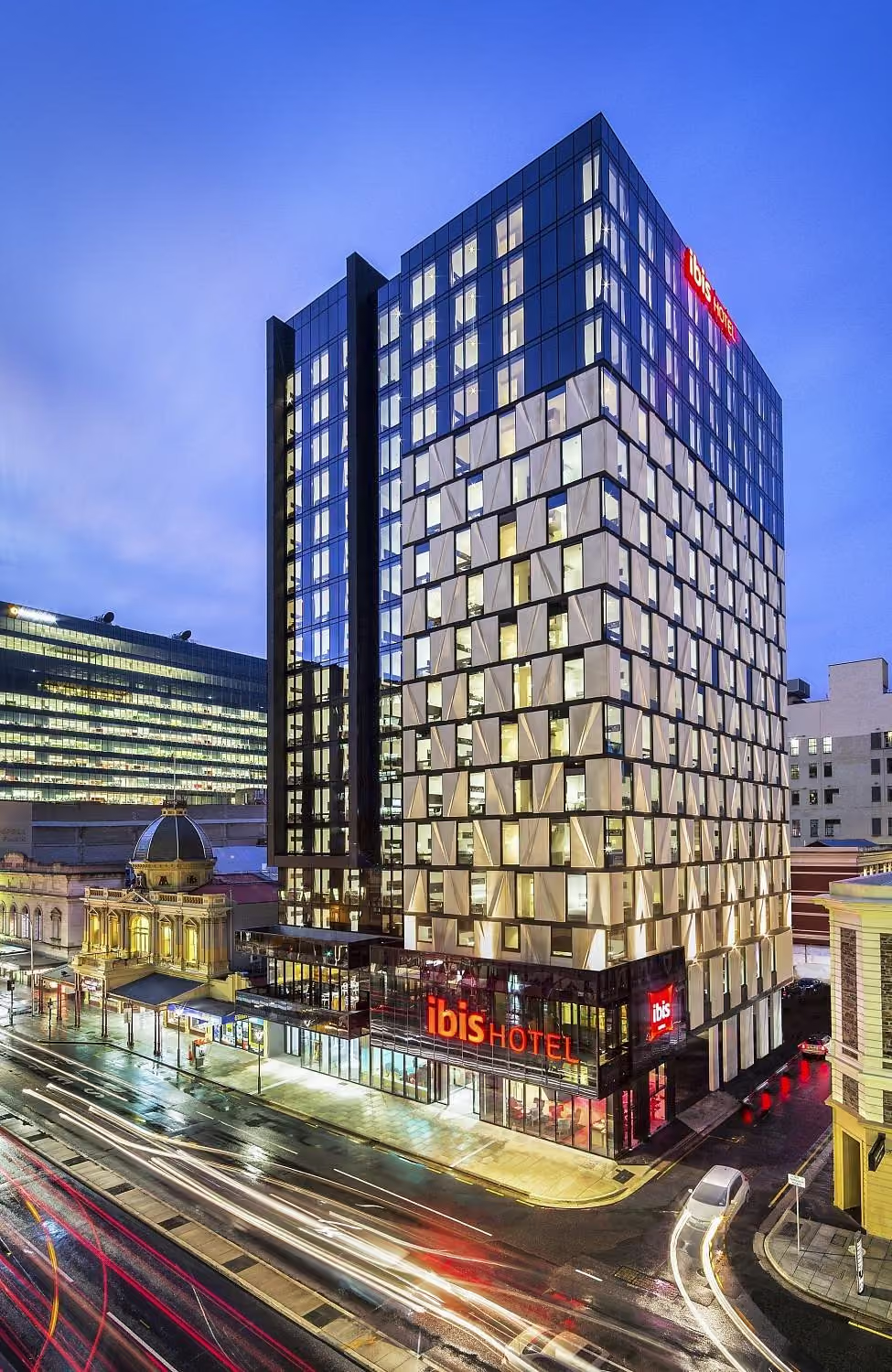
Ibis Adelaide
122 Grenfell Street Adelaide,
Adelaide, South Australia 5000
Australia
Phone:
(+61)8/815955888 Minute walk from venue
Minneappolis/St. Paul, Minnesota Area
Venue
The Functional Neurology Center
11055 Wayzata Blvd
Minnetonka, MN 55305
USA
Airport:
Schedule:
Friday: 2:00 PM to 6:00 PM
Saturday: 9:00 AM to 6:00 PM
Sunday: 9:00 AM to 6:00 PM
Time Zone:
Dress Code:
Suggested Hotels
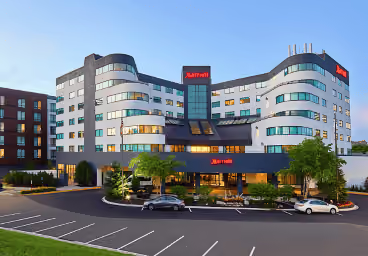
Minneapolis Marriott West
Orlando, Florida Area
Venue
Carrick Institute Learning Center
8910 Astronaut Blvd.
Cape Canaveral, FL 32920
USA
Phone:
Airport:
Schedule:
Friday: 2:00 PM to 6:00 PM
Saturday: 9:00 AM to 6:00 PM
Sunday: 9:00 AM to 6:00 PM
Time Zone:
Dress Code:
Suggested Hotels

Homewood Suites by Hilton Cape Canaveral-Cocoa Beach
This hotel is directly adjacent to the Carrick Institute Learning Center. It is about a 1-2 minute walk and has great views of rocket launches from the north side.
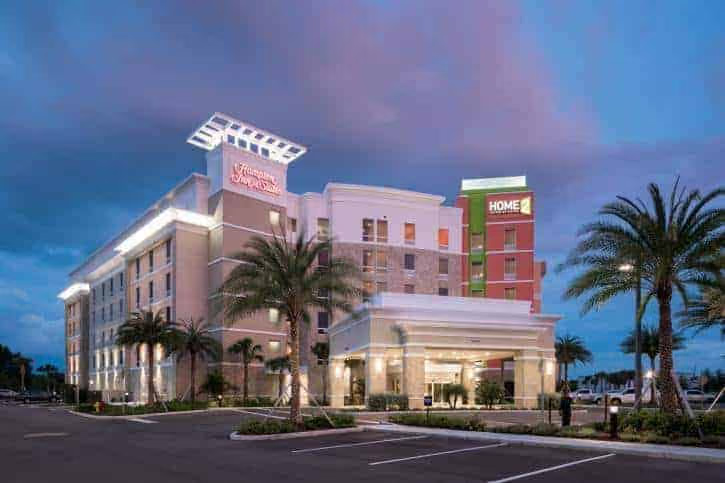
Hampton Inn & Suites Cape Canaveral Cruise Port
This hotel is just adjacent the Carrick Institute and is connected to the Homewood Suites. It will take approximately 2 minutes to walk to the Carrick Institute Learning Center. It has a pool, outdoor basketball court, and a gym.
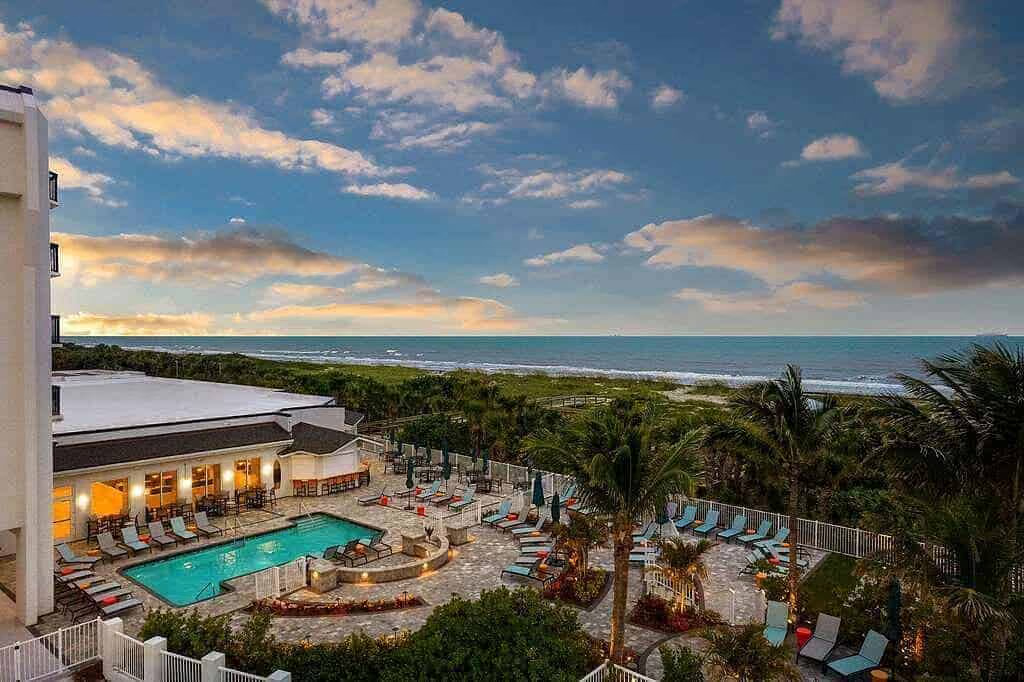
Hilton Garden Inn Cocoa Beach Oceanfront
This hotel is not walking distance from the Carrick Institute, but is right on the beach, just south of the Cocoa Beach Pier. You will need a car to get from the hotel to the Carrick Institute Learning Center. It is about a 5-10 minute drive depending on traffic and local events.
Also includes
Neurology of Movement/ Case Studies
Master the neural architecture of movement, from basal ganglia circuitry to clinical assessment of complex movement disorders. 25 CE credits.
$
$
(
$
The Carrick Institute team is ready to assist with enrollment, CE approval, or program planning. Email visit our CE Portal or Contact Us directly.