.png)

A clinically rigorous 25-hour board review covering the full functional neurology curriculum from neuroanatomy to complex clinical syndromes.
$
$
(
$
Course Description
The clinical complexity of neurological presentations continues to outpace the frameworks most clinicians were trained with. Patients with overlapping peripheral, autonomic, and central findings frequently remain unresolved within conventional diagnostic models, not because the answers do not exist, but because the clinical map is incomplete.
This course closes that gap. Across 25 CE hours, Dr. Matthew Antonucci guides clinicians through the full functional neurology board review curriculum, from the embryological foundations of neural development and the biophysics of membrane potentials to advanced clinical syndromes involving the brainstem, cerebellum, vestibular system, basal ganglia, and cranial nerves. Entrapment neuropathies, myopathies, autonomic disorders, pain neuroscience, and headache mechanisms are examined with the depth required for board-level mastery and the clinical precision required for real-world application.
What you’ll learn:
- Apply neuroanatomical localization across peripheral, spinal, and central levels
- Interpret electrodiagnostic findings to differentiate axonal and demyelinating pathology
- Identify cranial nerve syndromes and brainstem vascular lesion patterns
- Evaluate vestibular, cerebellar, and oculomotor dysfunction with clinical precision
- Recognize autonomic, pain, and cortical disorders using board-level diagnostic reasoning
More About This Course
Functional neurology board preparation demands more than memorization. It demands the kind of integrated clinical reasoning that allows a practitioner to move fluidly between a peripheral nerve finding, a brainstem localization, and a cortical syndrome, recognizing how each layer of the nervous system informs the others. This 25-hour board review course, presented by Dr. Matthew Antonucci, is built for clinicians who are ready to operate at that level.
The course covers the complete functional neurology curriculum with clinical precision. Topics span the organization and embryological development of the nervous system, neuronal cytoarchitecture and genetic expression, membrane biophysics and ion channel dynamics, neurotransmitter pharmacology, and the clinical implications of ionic and metabolic disorders. From there, the curriculum advances through the full peripheral nervous system, including nerve injury classification, electrodiagnosis, brachial and lumbar plexopathies, and entrapment neuropathies of both the upper and lower limbs. Myopathies, neuromuscular junction disorders, and polyneuropathies including Guillain-Barre syndrome, diabetic neuropathy, and Charcot-Marie-Tooth disease are examined with board-level rigor and direct clinical relevance.
Central nervous system content includes detailed coverage of spinal cord tracts, compressive myelopathy, cervical spondylytic myelopathy, and ALS. Cranial nerve anatomy and clinical syndromes from CN I through CN XII are reviewed comprehensively. The cerebellum, vestibular system, oculomotor system, basal ganglia, and autonomic nervous system receive dedicated attention, integrating functional organization with clinical assessment strategies and rehabilitation principles. Headache mechanisms, pain neuroscience, cortical lobe syndromes, and vascular neuroanatomy complete the curriculum.
Sample board examination questions are embedded throughout, reinforcing clinical reasoning across every major domain and preparing candidates for the specific reasoning demands of functional neurology certification.
Components
Educational Syllabus
- The Nervous System From Blueprint to Clinical Map
- From neurulation to neural crest cell differentiation, this topic establishes the developmental architecture underlying every clinical syndrome covered in the course. Understand how embryological errors manifest as diagnosable conditions including tethered cord, spina bifida, and neural tube defects.
- Neuronal Architecture and the Science of Brain Output
- Explore cytoarchitecture, axonal transport, tauopathy, alpha-synuclein, and immediate early gene responses. Understand how neuronal structure governs clinical expression and why cellular health is the foundation of every functional outcome you observe.
- Membrane Biophysics and the Language of Neural Firing
- Master resting membrane potential, ion channel types, action potential propagation, and refractory periods. Understand how ionic disorders including hyper and hypokalemia, hypercalcemia, and hyponatremia alter neuronal excitability in your patients.
- Neurotransmitters, Synaptic Modulation, and LTP
- From GABA and glutamate to dopamine, serotonin, and acetylcholine, this topic connects neurotransmitter pharmacology to clinical syndromes, receptor pharmacology, and the mechanisms underlying long-term potentiation and neuromodulation.
- Metabolic and Cofactor Disorders That Mimic Neurological Disease
- Galactosemia, PKU, Wilson disease, hypoglycemia, and B1, B6, B9, and B12 deficiencies produce neurological presentations that are frequently misattributed. Build the clinical pattern recognition to identify these conditions before they cause irreversible damage.
- Peripheral Nerve Injury, Electrodiagnosis, and Clinical Classification
- Understand nerve injury grading from neurapraxia to neurotmesis, master NCS and EMG interpretation for axonal versus demyelinating pathology, and apply entrapment neuropathy testing strategies to median, ulnar, and radial nerve syndromes.
- Brachial and Lumbar Plexopathies in Clinical Context
- Localize Erb's palsy, Dejerine-Klumke palsy, thoracic outlet syndrome, and lumbar plexus injuries with precision. Understand the anatomical logic that distinguishes root lesions from plexus lesions and guides clinical decision making.
- Entrapment Neuropathies of the Upper and Lower Limbs
- From carpal tunnel and cubital tunnel to piriformis syndrome, tarsal tunnel, and Morton's neuroma, gain the clinical reasoning to identify, localize, and differentiate the full spectrum of entrapment presentations in both limbs.
- Myopathies, Neuromuscular Junction Disorders, and Dystrophies
- Classify myopathic weakness patterns, distinguish myasthenia gravis from Lambert-Eaton syndrome, and recognize the muscular dystrophies including Duchenne, myotonic, and facioscapulohumeral by their clinical and electrodiagnostic signatures.
- Spinal Cord Tracts, Myelopathy, and Radiculopathy
- Command the ascending and descending tracts, localize compressive myelopathy, differentiate cervical spondylytic myelopathy from ALS and subacute combined degeneration, and apply the clinical tools that distinguish cervical from lumbar presentations.
- Cranial Nerves and Their Clinical Syndromes From CN I to CN XII
- Systematically review the anatomy, testing, and clinical pathology of all twelve cranial nerves, including brainstem lesion syndromes, acoustic neuromas, Bell's palsy, trigeminal neuropathy, and the full range of ocular motor palsies.
- Cerebellar Organization, Ataxia, and Clinical Assessment
- Map the phylogenetic and functional divisions of the cerebellum, identify the clinical signatures of flocculonodular, vermal, and hemispheric syndromes, and differentiate Friedreich ataxia, SCA subtypes, and gluten ataxia using examination-based reasoning.
- The Vestibular System, Oculomotor Control, and Rehabilitation
- Integrate semicircular canal and otolith physiology with clinical testing including caloric evaluation, BPPV diagnosis and repositioning, VOR assessment, and vestibular rehabilitation progressions across gaze stabilization exercise protocols.
- The Autonomic Nervous System and Its Clinical Disorders
- Evaluate sympathetic and parasympathetic integrity through Horner syndrome, POTS, orthostatic hypotension, and Raynaud phenomenon. Apply autonomic testing including Valsalva, head-up tilt, and heart rate variability to clinical decision making.
- Headache Mechanisms, Pain Neuroscience, and Cortical Syndromes
- Integrate migraine pathophysiology, cervicogenic headache, trigeminal neuralgia, central sensitization, and fibromyalgia with cortical lobe findings across the frontal, parietal, and temporal lobes for a complete board-ready clinical picture.
Venue, Hotels & Schedule
Adelaide, Australia
Venue
Australian Chiropractic College (ACC) Adelaide Campus
Adelaide Campus, Level 2/101 Grenfell St,
Adelaide SA 5000, Australia
Phone:
Airport:
Schedule:
Friday: 1:00 PM to 7:00 PM
Saturday: 9:00 AM to 7:00 PM
Sunday: 9:00 AM to 3:00 PM
Time Zone:
Dress Code:
Suggested Hotels

Ibis Adelaide
122 Grenfell Street Adelaide,
Adelaide, South Australia 5000
Australia
Phone:
(+61)8/815955888 Minute walk from venue
Minneappolis/St. Paul, Minnesota Area
Venue
The Functional Neurology Center
11055 Wayzata Blvd
Minnetonka, MN 55305
USA
Airport:
Schedule:
Friday: 2:00 PM to 6:00 PM
Saturday: 9:00 AM to 6:00 PM
Sunday: 9:00 AM to 6:00 PM
Time Zone:
Dress Code:
Suggested Hotels
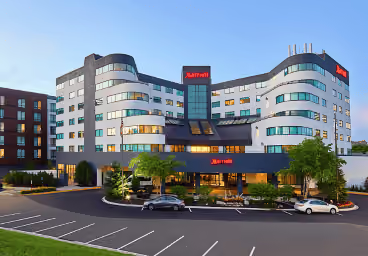
Minneapolis Marriott West
Orlando, Florida Area
Venue
Carrick Institute Learning Center
8910 Astronaut Blvd.
Cape Canaveral, FL 32920
USA
Phone:
Airport:
Schedule:
Friday: 2:00 PM to 6:00 PM
Saturday: 9:00 AM to 6:00 PM
Sunday: 9:00 AM to 6:00 PM
Time Zone:
Dress Code:
Suggested Hotels

Homewood Suites by Hilton Cape Canaveral-Cocoa Beach
This hotel is directly adjacent to the Carrick Institute Learning Center. It is about a 1-2 minute walk and has great views of rocket launches from the north side.
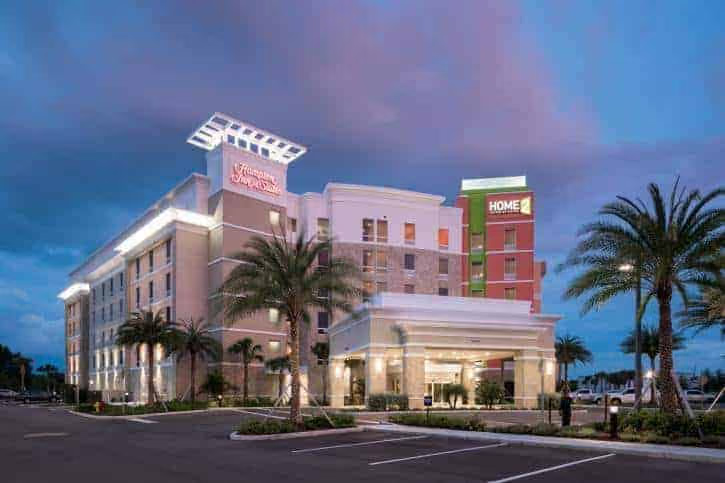
Hampton Inn & Suites Cape Canaveral Cruise Port
This hotel is just adjacent the Carrick Institute and is connected to the Homewood Suites. It will take approximately 2 minutes to walk to the Carrick Institute Learning Center. It has a pool, outdoor basketball court, and a gym.

Hilton Garden Inn Cocoa Beach Oceanfront
This hotel is not walking distance from the Carrick Institute, but is right on the beach, just south of the Cocoa Beach Pier. You will need a car to get from the hotel to the Carrick Institute Learning Center. It is about a 5-10 minute drive depending on traffic and local events.
Amsterdam, Netherlands Area
Venue
Amsterdam Brain Center
Henk Schijvenaarstraat
12031 VC. Haarlem
The Netherlands
Airport:
Schedule:
Friday: 1:00 PM to 7:00 PM
Saturday: 9:00 AM to 7:00 PM
Sunday: 9:00 AM to 3:00 PM
Time Zone:
Dress Code:
Suggested Hotels

Ambassador City Centre Hotel
Also includes

Board Review
A clinically rigorous 25-hour board review covering the full functional neurology curriculum from neuroanatomy to complex clinical syndromes.
$
$
(
$
The Carrick Institute team is ready to assist with enrollment, CE approval, or program planning. Email visit our CE Portal or Contact Us directly.