.png)

Hypoxia: Is It A Cause Or A Solution For Neurodegenerative Disease
Exploring whether oxygen deprivation drives or defends against neurodegeneration
Rethink oxygen's role in brain disease. Explore how hypoxia both threatens and potentially protects the aging, degenerating nervous system.
$
$
(
$
Course Description
Neurodegenerative disease remains one of the most complex challenges in clinical practice, and the role of oxygen availability sits at the center of that complexity. Clinicians working in functional medicine are increasingly encountering patients whose neurological trajectories demand a deeper mechanistic framework than standard care provides.
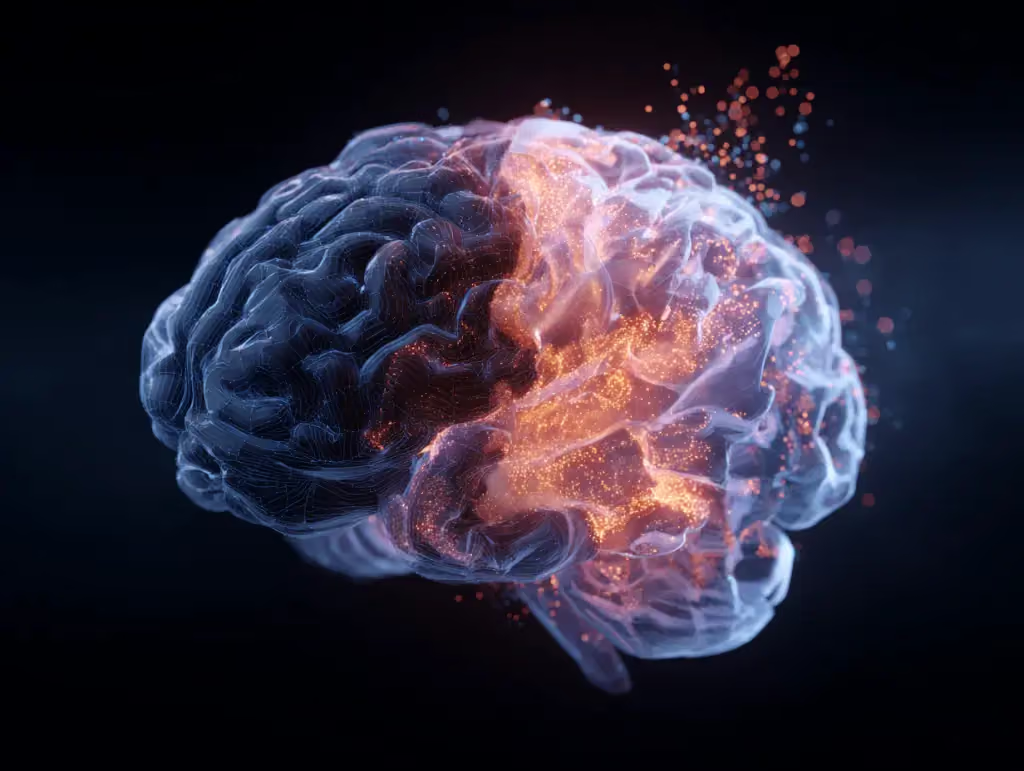
This 1-credit course with Dr. Jason Sonners investigates the paradoxical relationship between hypoxia and neurodegeneration. You will gain a clinically grounded understanding of how oxygen deprivation can function as both a pathological driver and a potential therapeutic signal, equipping you to integrate this framework into advanced patient care strategies.
What you’ll learn:
- Distinguish hypoxia's role as both a neurological stressor and adaptive signal
- Analyze how oxygen deprivation drives neuroinflammation and synaptic loss
- Evaluate HIF-1 alpha pathways and their neuroprotective clinical significance
- Identify patient presentations where hypoxic physiology shapes disease trajectory
- Integrate hypoxia frameworks into functional medicine neurodegenerative care plans
More About This Course
The relationship between oxygen availability and neurological disease is one of the most clinically consequential and least understood areas in functional medicine today. As neurodegenerative conditions rise in prevalence and complexity, clinicians need a mechanistic framework that goes beyond inflammation and genetics. Hypoxia sits at the intersection of metabolic function, mitochondrial health, vascular integrity, and neuronal survival, making it a critical variable in understanding conditions like Alzheimer's disease, Parkinson's disease, and other progressive neurological disorders. This course positions hypoxia not as a single threat, but as a physiological signal with a dual nature that informed clinicians are uniquely prepared to interpret.
This course builds your capacity to evaluate hypoxic mechanisms at a clinical level. You will examine how chronic or intermittent oxygen deprivation influences neuroinflammation, synaptic resilience, and cellular stress pathways. More importantly, you will explore the emerging and provocative evidence that controlled hypoxic exposure may activate neuroprotective signaling, including HIF-1 alpha pathways and mitochondrial adaptations that support neuronal longevity. The course bridges basic science with clinical application so that this knowledge is immediately usable in practice.
This training is designed for licensed clinicians in chiropractic, functional medicine, neurology, and integrative health who are already thinking beyond symptom management and want to engage the upstream biological mechanisms driving patient decline. It is especially relevant for practitioners working with aging populations, complex neurological presentations, or patients pursuing advanced preventive strategies.
Components
Educational Syllabus
- Understanding the Oxygen Paradox in Brain Health
- Oxygen is essential to neuronal survival, yet oxygen dynamics can also initiate the very cascades that accelerate neurodegeneration. This topic establishes the foundational science of hypoxia and why its effects on the brain are rarely one-dimensional.
- How Hypoxia Fuels Neuroinflammation and Cellular Decline
- Explore the mechanistic pathways by which insufficient oxygen delivery amplifies neuroinflammatory signaling, disrupts mitochondrial efficiency, and accelerates synaptic loss in degenerative neurological conditions.
- The Neuroprotective Signal: HIF-1 Alpha and Adaptive Responses
- Gain command of the HIF-1 alpha pathway and understand how the brain's own oxygen-sensing machinery can, under the right conditions, activate survival responses that slow neurodegeneration and support cellular resilience.
- Clinical Application: Using Hypoxic Frameworks in Practice
- Translate the science into clinical strategy. Learn to identify patients whose neurological trajectory is shaped by hypoxic physiology and build functional medicine approaches that address oxygen dynamics as a therapeutic target.
Venue, Hotels & Schedule
Also includes

Hypoxia: Is It A Cause Or A Solution For Neurodegenerative Disease
Rethink oxygen's role in brain disease. Explore how hypoxia both threatens and potentially protects the aging, degenerating nervous system.
$
$
(
$
The Carrick Institute team is ready to assist with enrollment, CE approval, or program planning. Email visit our CE Portal or Contact Us directly.