.png)
Spinal Cord
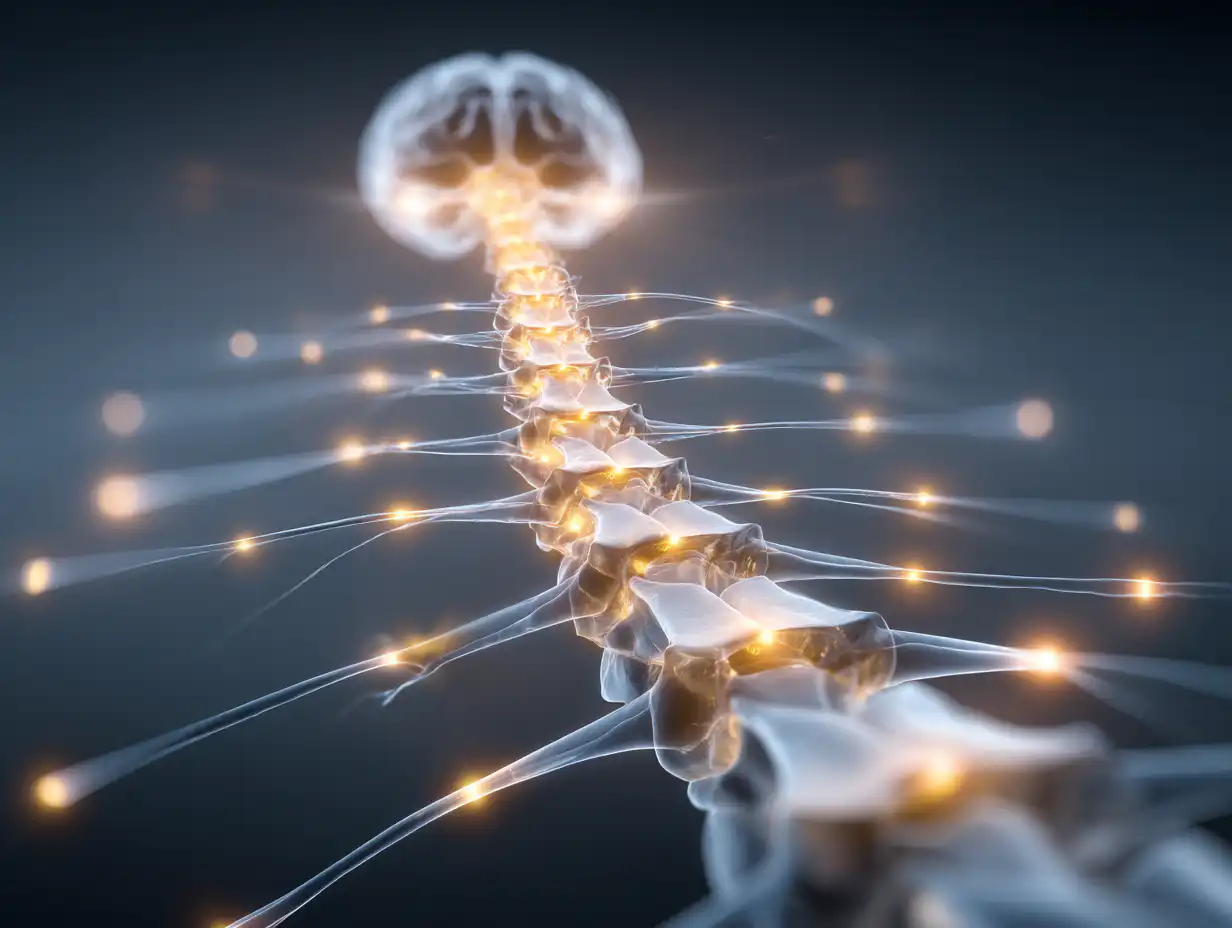
The spinal cord connects the brain to the body, protected by the vertebral column. While this offers protection, it can also expose the spinal cord to injury due to the limited space within the column.
$
$
(
$
Course Description
The spinal cord is the main conduit that connects the brain to the rest of the body. Being encased within the vertebral column can act as a double edge sword. On one hand it provides protection and on the other hand it can expose the spinal cord to damage through a myriad of degenerative and traumatic conditions. This module we review the structure/function of the spinal cord and those degenerative, traumatic, inflammatory, and vascular conditions that impair its function.
What you’ll learn:
- Understand spinal cord structure and function.
- Recognize the protective and risky role of the vertebral column.
- Identify conditions that impair spinal cord function.
- Explore clinical impacts of spinal cord dysfunction.
Components
Educational Syllabus
- Resource Library for CNS04
- About this Course
- Journal Articles for CNS04
- Download: Download the Notes for CNS04
- Chapter 1 - Development of the Spinal Cord
- Lesson: Development of the Spinal Cord
- Quiz: Chapter 1 Quiz
- Chapter 2 - Gross Anatomy
- Lesson: Gross Anatomy Pt. 1
- Lesson: Gross Anatomy Pt. 2
- Quiz: Chapter 1 Quiz
- Chapter 3 - Case Study 1
- Lesson: Case Study 1
- Chapter 4 - Ascending Sensory Tracts
- Lesson: Ascending Sensory Tracts
- Quiz: Chapter 4 Quiz
- Chapter 5 - Clinical Syndromes
- Lesson: Clinical Syndromes
- Quiz: Chapter 5 Quiz
- Chapter 6 - Case Study 2
- Lesson: Case Study 2 Pt. 1
- Lesson: Case Study 2 Pt. 2
- Chapter 7 -More Clinical Syndromes
- Lesson: More Clinical Syndromes
- Quiz: Chapter 7 Quiz
- Chapter 8 - Case Study 3
- Lesson: Case Study 3 Pt. 1
- Lesson: Case Study 3 Pt. 2
- You're Halfway There!
- Chapter 9 - Day 1 Quick Review
- Lesson: Day 1 Quick Review
- Chapter 10 - Transverse Myelitis and Syringomelia
- Lesson: Transverse Myelitis and Syringomelia
- Quiz: Chapter 10 Quiz
- Chapter 11 - The Pathophysiology of Root Lesions
- Lesson: The Pathophysiology of Root Lesions
- Quiz: Chapter 11 Quiz
- Chapter 12 - Cervical and Lumbar Root Lesions
- Lesson: Cervical and Lumbar Root Lesions
- Quiz: Chapter 12 Quiz
- Chapter 13 - Case Study 4
- Lesson: Case Study 4 Pt. 1
- Lesson: Case Study 4 Pt. 2
- Chapter 14 - Exam Demo
- Lesson: Exam Demo
- Chapter 15 - Spinal Cord Cauda Equina Syndrome
- Lesson: Spinal Cord Cauda Equina Syndrome
- Quiz: Chapter 15 Quiz
Venue, Hotels & Schedule
Also includes
Spinal Cord
The spinal cord connects the brain to the body, protected by the vertebral column. While this offers protection, it can also expose the spinal cord to injury due to the limited space within the column.
$
$
(
$
The Carrick Institute team is ready to assist with enrollment, CE approval, or program planning. Email visit our CE Portal or Contact Us directly.