.png)

Master pain neuroscience and head/facial pain mechanisms to elevate your clinical reasoning and expand what's possible for complex patients.
$
$
(
$

Course Description
Patients with chronic pain, migraines, facial neuralgias, and complex headache disorders deserve more than symptom management. Yet the neuroscience underlying these conditions moves faster than most clinical training can keep pace with.
This 25-hour functional neurology course closes that gap. You will build a clinically integrated command of pain processing from peripheral sensitization to cortical reorganization, master the diagnostic and classification frameworks that define modern headache medicine, and develop confident treatment reasoning across neuromodulation, manual therapy, and multimodal care. Designed for the clinician who already thinks in systems.
What you’ll learn:
- Apply current pain neuroscience models to clinical case reasoning
- Classify and differentially diagnose primary and secondary headaches
- Identify central sensitization patterns driving chronic pain presentations
- Analyze trigeminovascular and trigeminal nuclear pain mechanisms
- Select neuromodulation and manual therapy approaches by pain phenotype
More About This Course
Pain is no longer a symptom. It is a system. The neuroscience of chronic pain, headache, and facial pain has undergone a profound transformation over the past two decades, moving from tissue-damage models toward a sophisticated understanding of central sensitization, cortical reorganization, neuroplasticity, and the biopsychosocial architecture of pain experience. For clinicians working in functional neurology, chiropractic neurology, rehabilitation, or integrative practice, this shift represents both a challenge and a significant clinical opportunity.
CNS08: Pain and Head/Facial Pain is a 25-hour advanced continuing education course that translates current pain neuroscience into a clinically actionable framework. The course spans the full spectrum of pain science, from TRP channel sensitization and dorsal horn laminar processing to the trigeminovascular system, cortical spreading depression, and the brain changes that define chronic pain. You will develop a working command of nociceptive, inflammatory, and neuropathic pain mechanisms; master the International Headache Society classification system; and build diagnostic and treatment reasoning across migraine, cluster headache, trigeminal neuralgia, cervicogenic headache, CRPS, fibromyalgia, and vestibular migraine.
This course is built for licensed clinicians who already understand that pain is an output of the nervous system and want to work at the level where that understanding becomes therapeutic precision. Whether you see complex headache patients, post-injury chronic pain cases, or facial pain presentations that have exhausted conventional pathways, this training gives you the neurological depth to reason forward with confidence.
Presented by Dr. Matthew Antonucci, a distinguished chiropractic neurologist and Carrick Institute faculty member, this course integrates current peer-reviewed literature with practical clinical application at every stage. Dr. Antonucci brings functional neurology expertise to topics where diagnostic clarity and treatment specificity matter most, including neuromodulation, graded motor imagery, mirror therapy, electrotherapy selection, and advanced diagnostic imaging indications. This is the course for clinicians who are ready to work at the leading edge of pain science.
Components
Educational Syllabus
- The Neuroscience of Pain as a Protective Output
- Pain is not simply a signal from damaged tissue. Explore how the nervous system integrates sensory, emotional, and memory-based inputs to generate pain as a behavioral response, and what that means for clinical assessment.
- Pain Theories from Gate Control to Neuromatrix
- Trace the evolution of pain science from Descartes to Melzack. Understand how Gate Control, Neuromatrix, and Biopsychosocial models each contribute to how you interpret and address chronic pain presentations in practice.
- Peripheral Sensitization and Nociceptor Mechanisms
- Master TRP channel function, inflammatory mediator cascades, and the receptor-level changes that produce allodynia and hyperalgesia. Build the peripheral neuroscience foundation your clinical reasoning depends on.
- Dorsal Horn Processing and Central Sensitization
- Explore laminar organization, WDR neuron dynamics, and the synaptic plasticity mechanisms that drive the transition from acute to chronic pain. Understand central sensitization as a shift in system state, not just severity.
- Chronic Pain and Brain Reorganization
- Examine how chronic pain rewires cortical and subcortical structures, including gray matter changes, homuncular smudging, default mode network disruption, and the clinical implications of neuroplastic reorganization.
- Neuropathic Pain: Mechanisms, Grading, and Assessment
- Differentiate peripheral and central neuropathic pain by mechanism. Apply validated screening tools including DN4, LANSS, and painDETECT, and understand the neurophysiology behind spontaneous firing, ectopic discharge, and loss of inhibition.
- The Trigeminal System: Anatomy, Nuclei, and Clinical Connections
- Build a precise working map of trigeminal anatomy from peripheral branches to brainstem nuclei. Understand how the spinal trigeminal nucleus caudalis integrates cervical and facial input to produce referred head and facial pain.
- Headache Classification and Red Flag Recognition
- Apply the International Headache Society ICHD-3 framework to distinguish primary from secondary headache disorders. Develop systematic clinical reasoning for recognizing warning signs that require immediate diagnostic escalation.
- Migraine: Phases, Pathophysiology, and Trigeminovascular Activation
- Trace migraine from prodrome through postdrome using current neurobiological models. Understand cortical spreading depression, CGRP release, trigeminovascular pathway activation, and the role of the hypothalamus in attack initiation.
- Cluster Headache and Trigeminal Autonomic Cephalalgias
- Master the diagnostic criteria, pain profile, and autonomic features of cluster headache. Navigate the four treatment layers from acute oxygen and triptans through transitional and preventive care to refractory neuromodulation options.
- Facial Neuralgias: Trigeminal, Glossopharyngeal, and Beyond
- Differentiate trigeminal neuralgia, glossopharyngeal neuralgia, occipital neuralgia, Eagle syndrome, and giant cell arteritis by mechanism and clinical feature. Understand neurovascular compression, demyelination, and the role of central sensitization.
- Cervicogenic and Tension Headache Mechanisms
- Understand the trigeminocervical nucleus as the anatomical basis for cervicogenic headache. Apply pain referral patterns from cervical structures, clinical examination strategies, and manual therapy rationale for this best-understood headache type.
- Vestibular Migraine, Menstrual Migraine, and Special Presentations
- Explore vestibular migraine pathophysiology through cortical, thalamic, and trigeminovascular lenses. Address menstrual migraine hormonal mechanisms and examine secondary headache disorders including Chiari malformation and low CSF pressure.
- CRPS and Fibromyalgia: Central Pain Syndromes in Practice
- Apply diagnostic criteria for CRPS and fibromyalgia using current frameworks. Explore graded motor imagery, mirror therapy, the Malibu treatment algorithm, and tDCS as evidence-supported tools for cortical reorganization and pain reduction.
- Neuromodulation and Electrotherapy Selection for Pain
- Navigate the full spectrum from TENS and interferential current to rTMS, tDCS, vagal nerve stimulation, occipital nerve stimulation, and sphenopalatine ganglion stimulation. Match modality to pain phenotype with a clinically grounded decision framework.
Venue, Hotels & Schedule
Adelaide, Australia
Venue
Australian Chiropractic College (ACC) Adelaide Campus
Adelaide Campus, Level 2/101 Grenfell St,
Adelaide SA 5000, Australia
Phone:
Airport:
Schedule:
Friday: 1:00 PM to 7:00 PM
Saturday: 9:00 AM to 7:00 PM
Sunday: 9:00 AM to 3:00 PM
Time Zone:
Dress Code:
Suggested Hotels

Ibis Adelaide
122 Grenfell Street Adelaide,
Adelaide, South Australia 5000
Australia
Phone:
(+61)8/815955888 Minute walk from venue
Minneappolis/St. Paul, Minnesota Area
Venue
The Functional Neurology Center
11055 Wayzata Blvd
Minnetonka, MN 55305
USA
Airport:
Schedule:
Friday: 2:00 PM to 6:00 PM
Saturday: 9:00 AM to 6:00 PM
Sunday: 9:00 AM to 6:00 PM
Time Zone:
Dress Code:
Suggested Hotels
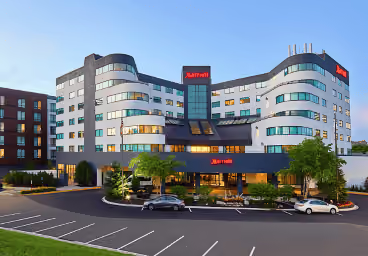
Minneapolis Marriott West
Orlando, Florida Area
Venue
Carrick Institute Learning Center
8910 Astronaut Blvd.
Cape Canaveral, FL 32920
USA
Phone:
Airport:
Schedule:
Friday: 2:00 PM to 6:00 PM
Saturday: 9:00 AM to 6:00 PM
Sunday: 9:00 AM to 6:00 PM
Time Zone:
Dress Code:
Suggested Hotels

Homewood Suites by Hilton Cape Canaveral-Cocoa Beach
This hotel is directly adjacent to the Carrick Institute Learning Center. It is about a 1-2 minute walk and has great views of rocket launches from the north side.
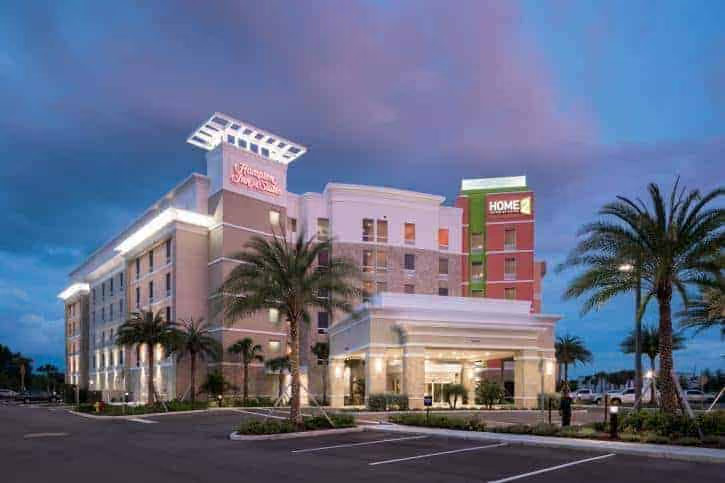
Hampton Inn & Suites Cape Canaveral Cruise Port
This hotel is just adjacent the Carrick Institute and is connected to the Homewood Suites. It will take approximately 2 minutes to walk to the Carrick Institute Learning Center. It has a pool, outdoor basketball court, and a gym.

Hilton Garden Inn Cocoa Beach Oceanfront
This hotel is not walking distance from the Carrick Institute, but is right on the beach, just south of the Cocoa Beach Pier. You will need a car to get from the hotel to the Carrick Institute Learning Center. It is about a 5-10 minute drive depending on traffic and local events.
Also includes
Pain & Head/Facial Pain
Master pain neuroscience and head/facial pain mechanisms to elevate your clinical reasoning and expand what's possible for complex patients.
$
$
(
$
The Carrick Institute team is ready to assist with enrollment, CE approval, or program planning. Email visit our CE Portal or Contact Us directly.