.png)
Master the full clinical neurological exam and evidence-based rehabilitation protocols that elevate diagnostic precision and patient outcomes.
$
$
(
$

Course Description
Complex neurological presentations demand more than pattern recognition. When patients arrive with overlapping vestibular, autonomic, cerebellar, and cranial nerve findings, the clinician who can systematically localize dysfunction and map it to a targeted rehabilitation strategy becomes the practitioner others cannot replicate.
This 25-hour course builds that capability from the ground up. Dr. Matthew Antonucci guides licensed clinicians through the complete neurological examination, covering history-based localization, ionic and metabolic screening, cranial nerve testing, oculomotor and vestibular assessment, and lobar dysfunction evaluation. Rehabilitation principles spanning BPPV maneuver selection, vestibular adaptation, saccadic training, convergence therapy, frontal and parietal lobe rehab, and electroneural modulation translate every diagnostic finding into actionable clinical strategy.
What you’ll learn:
- Localize neurological dysfunction using history and systematic clinical exam findings
- Assess cranial nerve, oculomotor, vestibular, and autonomic systems at bedside
- Identify BPPV canal variants and select the appropriate repositioning maneuver
- Design progressive vestibular, saccadic, and convergence rehabilitation programs
- Apply electroneural modulation including galvanic, TENS, and vagal stimulation
More About This Course
The neurological examination is the most powerful diagnostic instrument in clinical practice, yet its full scope remains underutilized in most clinical settings. Patients presenting with dizziness, gait instability, tremor, visual complaints, autonomic dysregulation, and cognitive changes are increasingly common across chiropractic neurology, functional neurology, rehabilitation medicine, and integrative practice. Clinicians trained to perform a thorough, systematic neurological exam paired with targeted rehabilitation protocols occupy a distinct clinical tier, one defined by diagnostic confidence and measurable patient outcomes.
Examination and Rehabilitation in Functional Neurology is a comprehensive 25-credit-hour advanced training program that transforms the neurological examination from a checklist into a precision localization tool. The course opens with foundational examination methodology, including history-based localization by chief complaint, motor and sensory testing, and screening for ionic and metabolic disturbances such as electrolyte dysregulation, vitamin deficiencies, and autonomic disorders. From there, the curriculum advances into cranial nerve assessment, oculomotor examination covering fixation, vergence, saccades, smooth pursuits, and nystagmus classification, and a deep investigation of vestibular dysfunction including BPPV variant identification, VOR testing, and caloric interpretation.
The rehabilitation curriculum is equally rigorous. Clinicians gain structured frameworks for vestibular adaptation therapy, BPPV canalith repositioning across all canal variants, saccadic and pursuit rehabilitation, convergence insufficiency treatment, frontal and parietal lobe cognitive rehabilitation using tools such as the Interactive Metronome, Trail Making Test, and antisaccade paradigms, and electroneural modulation using galvanic vestibular stimulation, TENS, and transcutaneous vagal nerve stimulation.
This course is designed for licensed healthcare clinicians including doctors of chiropractic, neurologists, physical therapists, occupational therapists, and other post-graduate practitioners seeking to expand their functional neurology competency, deepen their diagnostic precision, and deliver rehabilitation strategies grounded in contemporary neuroscience.
Components
Educational Syllabus
- The Art of Neurological Localization
- Build a clinician's most powerful diagnostic skill. Learn to map patient history, symptom quality, and onset patterns to specific neurological structures, transforming the chief complaint into a precise localization hypothesis.
- Metabolic and Ionic Mastery at Bedside
- Recognize how electrolyte imbalances, vitamin deficiencies, and acid-base disturbances manifest neurologically. Learn clinical signs for hypo and hyperkalemia, calcium dysregulation, B-vitamin deficiencies, and respiratory acidosis.
- Unlocking the Motor and Sensory Exam
- Master graded muscle testing, reflex rating, and the full sensory battery including pinprick, light touch, vibration, and joint position sense. Build the pattern recognition that distinguishes peripheral from central involvement.
- The Visual System as a Neurological Window
- Use physiologic blind spot mapping, pupillary light reflexes, RAPD testing, and near-light dissociation to reveal optic nerve, midbrain, and cortical pathology invisible to standard screening.
- Cranial Nerve Examination From I to XII
- Conduct a clinically driven cranial nerve exam covering olfaction, vision, pupillary control, ocular motor function, trigeminal reflexes, facial symmetry, vestibular-ocular testing, and bulbar function with precision localization value.
- Oculomotor Precision: Nystagmus, Gaze, and Fixation
- Classify nystagmus by direction, type, and clinical context. Assess gaze-evoked nystagmus, Alexander's Law, fixation stability, and saccadic intrusions to differentiate cerebellar, vestibular, and brainstem origins.
- Vergence, Tropias, and Phorias in Clinical Practice
- Assess convergence insufficiency and excess, perform cover-uncover and Maddox rod testing, apply the Parks-Bielschowsky three-step test for hypertropia, and distinguish paralytic from nonparalytic strabismus with confidence.
- Vestibular Dysfunction: From Assessment to Interpretation
- Perform and interpret the full vestibular exam including head impulse testing, VOR gain assessment, dynamic visual acuity, caloric testing, Fukuda step test, and subjective visual vertical to localize peripheral and central lesions.
- BPPV: Diagnosis and Repositioning Across All Canals
- Identify posterior, horizontal, and anterior canal BPPV variants using Dix-Hallpike, roll testing, and bow-and-lean maneuvers. Select and execute the optimal repositioning maneuver including Epley, Gufoni, Barbecue, and half-somersault.
- Vestibular Rehabilitation: Principles and Progression
- Design evidence-based vestibular adaptation programs using gaze stabilization, 0X, 1X, and 2X viewing exercises, visual motion desensitization, cervicogenic dizziness protocols, and structured progression variables.
- Frontal and Parietal Lobe Examination and Rehabilitation
- Assess frontal lobe integrity through Trail Making, antisaccade, Stroop, Go-No-Go, finger tap, and frontal release sign testing. Apply rehabilitation strategies including Interactive Metronome, digit substitution, and dual-task training.
- Temporal Lobe Dysfunction: Recognition and Clinical Significance
- Identify temporal lobe pathology through testing for prosopagnosia, amusia, deja vu phenomena, automatisms, palinopsia, and aphasia variants. Understand clinical implications for memory, language, and sensory integration.
- Tremor and Hyperkinetic Movement Disorder Examination
- Differentiate essential, cerebellar, Parkinsonian, orthostatic, and physiologic tremors. Recognize and classify hyperkinetic dyskinesias including myoclonus, dystonia, tics, chorea, and hemiballismus at the bedside.
- Electroneural Modulation: Galvanic, TENS, and Vagal Stimulation
- Apply galvanic vestibular stimulation, transcutaneous TENS, interferential current, and auricular and carotid vagal nerve stimulation with clinical rationale, dosing parameters, and electrode placement protocols.
- Advanced Rehabilitation: MdDS, Meniere's, and Motion Sensitivity
- Manage Mal de Debarquement using optokinetic stimulation and velocity storage reversal. Address Meniere's disease with tympanic pressure therapy. Treat visual motion sensitivity through graded optokinetic and self-motion rehabilitation.
Venue, Hotels & Schedule
Adelaide, Australia
Venue
Australian Chiropractic College (ACC) Adelaide Campus
Adelaide Campus, Level 2/101 Grenfell St,
Adelaide SA 5000, Australia
LEVEL 3, in the DANIEL ROOM
Access Info:
Phone:
Airport:
Schedule:
Friday: 1:00 PM to 7:00 PM
Saturday: 9:00 AM to 7:00 PM
Sunday: 9:00 AM to 3:00 PM
Time Zone:
Dress Code:
Suggested Hotels

Ibis Adelaide
122 Grenfell Street Adelaide,
Adelaide, South Australia 5000
Australia
Phone:
(+61)8/815955888 Minute walk from venue
Minneappolis/St. Paul, Minnesota Area
Venue
The Functional Neurology Center
11055 Wayzata Blvd
Minnetonka, MN 55305
USA
Airport:
Schedule:
Friday: 2:00 PM to 6:00 PM
Saturday: 9:00 AM to 6:00 PM
Sunday: 9:00 AM to 6:00 PM
Time Zone:
Dress Code:
Suggested Hotels
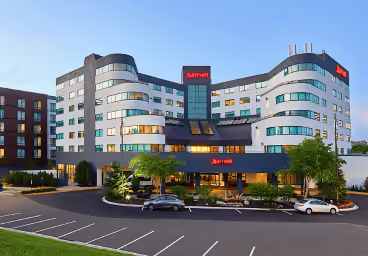
Minneapolis Marriott West
Orlando, Florida Area
Venue
Carrick Institute Learning Center
8910 Astronaut Blvd.
Cape Canaveral, FL 32920
USA
Phone:
Airport:
Schedule:
Friday: 2:00 PM to 6:00 PM
Saturday: 9:00 AM to 6:00 PM
Sunday: 9:00 AM to 6:00 PM
Time Zone:
Dress Code:
Suggested Hotels

Homewood Suites by Hilton Cape Canaveral-Cocoa Beach
This hotel is directly adjacent to the Carrick Institute Learning Center. It is about a 1-2 minute walk and has great views of rocket launches from the north side.
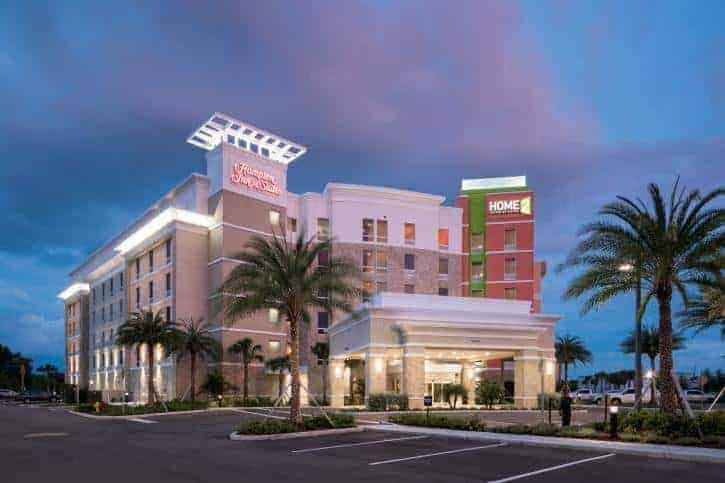
Hampton Inn & Suites Cape Canaveral Cruise Port
This hotel is just adjacent the Carrick Institute and is connected to the Homewood Suites. It will take approximately 2 minutes to walk to the Carrick Institute Learning Center. It has a pool, outdoor basketball court, and a gym.

Hilton Garden Inn Cocoa Beach Oceanfront
This hotel is not walking distance from the Carrick Institute, but is right on the beach, just south of the Cocoa Beach Pier. You will need a car to get from the hotel to the Carrick Institute Learning Center. It is about a 5-10 minute drive depending on traffic and local events.
Amsterdam, Netherlands Area
Venue
Amsterdam Brain Center
Henk Schijvenaarstraat
12031 VC. Haarlem
The Netherlands
Airport:
Schedule:
Friday: 1:00 PM to 7:00 PM
Saturday: 9:00 AM to 7:00 PM
Sunday: 9:00 AM to 3:00 PM
Time Zone:
Dress Code:
Suggested Hotels
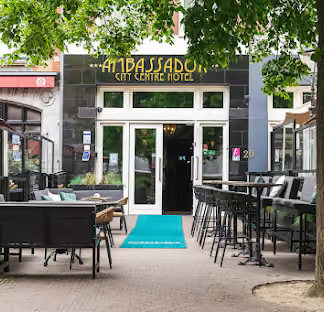
Ambassador City Centre Hotel
Also includes

Examination & Rehabilitation In Functional Neurology
Master the full clinical neurological exam and evidence-based rehabilitation protocols that elevate diagnostic precision and patient outcomes.
$
$
(
$
The Carrick Institute team is ready to assist with enrollment, CE approval, or program planning. Email visit our CE Portal or Contact Us directly.