.png)

BTSP: The Discovery of Instantaneous Neuroplasticity
.avif)
The Brain's One-Shot Rewrite — and How Skilled Clinicians Have Been Working With It All Along
A new discovery in synaptic biology refines a century-old definition of plasticity — and helps explain why one well-targeted stimulus can produce immediate, measurable change in patients whose imaging shows nothing wrong.
The Patient Who Could Not Forget Forgetting
There is a patient in the history of neuroscience known by his initials, H.M. In 1953, surgeons removed parts of both of his medial temporal lobes — including most of his hippocampi — to treat severe epilepsy. He survived the operation and lived for nearly six more decades. He kept his vocabulary, his personality, his motor skills. He could carry on a conversation. But he could not form new declarative memories. Every introduction was a first introduction. Every meal was strange in a way no other meal had been.
H.M. taught the field that the hippocampus was where the brain's capacity to remember a single experience lived. Decades later, neuroscientists could describe what the hippocampus did. They could not yet explain how it did it.
The standard rules of synaptic plasticity — the rules taught in medical schools and graduate programs for half a century — predicted that learning should be slow. Repetitive. Patient. The brain, by those rules, should not be able to remember a hallway from a single walk through it. And yet, somehow, it does.
The Old Story, and Why It Wasn't Enough
The textbook account of learning is roughly this. When two neurons fire together, the synapse between them grows stronger. Donald Hebb proposed the idea in 1949. A generation of neuroscientists, beginning with the discovery of long-term potentiation in the 1970s, spent decades confirming it. Its modern form — spike timing-dependent plasticity, or STDP — operates on a timescale of tens of milliseconds and typically requires dozens or hundreds of precisely paired activations to produce a substantial change.
That mechanism is real. It is not, however, fast enough to explain a great deal of what brains demonstrably do. Memory of a single conversation. Recognition of a face seen yesterday. The way a single concussion can quietly rewire balance, gaze, and autonomic tone for months afterward. By the math of classical Hebbian learning, none of these should be possible. The brain ought to require dozens of repetitions, and patients ought to have dozens of concussions before symptoms emerge.
The brain is not always slow, and patients are not always patient.
A Beautiful Old Sentence Begins to Crack
In 1890, William James published a chapter in The Principles of Psychology that contains one of the finest definitions of brain plasticity ever written:
"Plasticity, then, in the wide sense of the word, means the possession of a structure weak enough to yield to an influence, but strong enough not to yield all at once."
For more than a century, that sentence has been the working philosophy of the field. Plasticity had to be a balance. The brain had to be malleable enough to learn from experience, but resistant enough not to be overwritten by every passing input. The implicit picture: a slightly soft clay, taking impressions only after sustained, repeated pressure. Long-term potentiation slotted neatly into that view. So did STDP. The whole edifice of modern learning theory was, in essence, a careful elaboration of James's sentence.
That picture turns out to be incomplete.
In 2017, a series of experiments from Jeffrey Magee's laboratory described something the field had not seen before. Recording from neurons in the hippocampus of behaving mice, the researchers observed silent cells — neurons with no apparent role in encoding the animal's environment — abruptly become place cells following a single internal event called a dendritic plateau potential. One plateau. One trial. A fully formed map of where the animal was in space, written in a heartbeat.
They named the phenomenon behavioral timescale synaptic plasticity, or BTSP. In the years since, it has been confirmed, extended, and characterized as a distinct form of plasticity that breaks nearly every restriction Hebbian learning was supposed to obey. It is fast — single-trial. It operates on a timescale of seconds rather than milliseconds. It is bidirectional, meaning it can strengthen and weaken connections in the same moment. And critically, it is not driven by repetition. It is driven by an instructive signal — a teaching cue arriving from a higher-order region of the brain at exactly the right place at exactly the right time.
James's clay metaphor cracks under that result. The brain, it turns out, does not protect itself from drastic change by yielding gradually. It protects itself by gating drastic change behind a very specific kind of convergence — and then, when the gating conditions are met, it yields all at once.
Two Streams Must Agree
To see why BTSP matters clinically, it helps to understand how the brain pulls it off, because the mechanism is unexpectedly elegant.
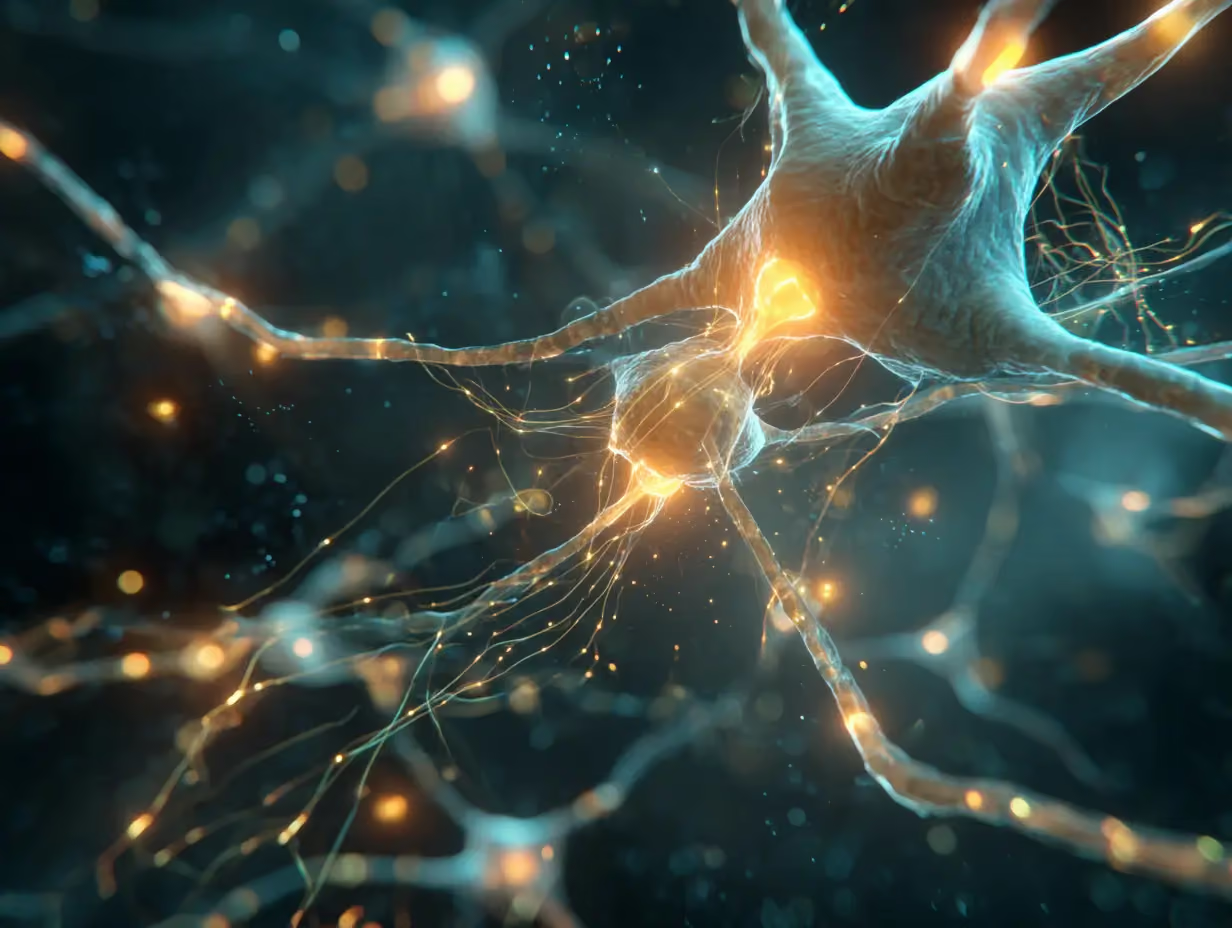
A pyramidal neuron — the workhorse cell of the cortex and hippocampus — is not a single integrating unit. It has two functionally distinct compartments. The proximal dendrites, near the cell body, receive moment-to-moment data from the previous region in the processing stream. What is happening right now. The distal dendrites, far out in the apical tuft, receive a different kind of signal — input from higher-order regions carrying context, expectation, attention, and learning targets. Information about what should matter.
For a plateau potential to fire, both streams must agree. The local data must coincide with the higher-order context. Neither alone is enough. Mechanically, it is a vault that requires two keys — one held by the system reporting on what is happening, the other held by the system reporting on what is important. Only when both turn at the same moment does the vault open and the network reorganize itself.
This is the brain's answer to William James. It is not a uniformly resistant medium yielding to repeated pressure. It is a precisely gated system that can yield enormously, instantly, but only when two specific signals converge — and it is held in check the rest of the time by local inhibitory circuits whose entire job is to prevent unauthorized plateaus from firing.
The Five-Second Memory Inside Every Synapse
There is one more property of BTSP worth understanding, because it explains how a synaptic mechanism can plausibly account for behavior — for learning that links events separated by real time.
The plateau itself is brief, lasting only a few hundred milliseconds. But the rewiring it causes reaches outward in time, both backward and forward, for several seconds. This works because every active synapse leaves behind a kind of biochemical residue — an eligibility trace — that lingers for a few seconds after activation. If a plateau fires during that window, every recently active synapse gets adjusted. Synapses that fired close to the plateau are strengthened. Synapses that were already strong but not part of the new pattern are weakened.
In other words: every synapse that fires raises a hand and says remember me. The hand stays up for about five seconds. If, during that window, the network receives a teaching signal — a plateau triggered by the convergence of local data and higher-order context — every raised hand gets factored into the rewrite. Otherwise the hands fall and the moment dissolves.
This means the brain is not just writing new connections. It is also actively erasing old ones every time a teaching signal cuts through. A single moment of instructive input can both add a representation and dim the one it replaces.
What This Looks Like in a Clinic
The clinical discipline that has been working with this kind of network logic for more than four decades is Functional Neurology. A formal definition published earlier this year describes it as "a clinical discipline that assesses neural network function via efferent expression and performs closed-loop modulation of integration integrity using targeted stimuli, through architecturally informed reasoning."
Translated into ordinary words: a Functional Neurology practitioner reads the nervous system through what it produces — eye movements, posture, reflexes, autonomic tone — uses anatomy to infer which networks are dysfunctional, applies a precisely chosen stimulus, and watches what happens. The patient's response in real time tells the clinician whether the hypothesis was correct and what to do next. Each stimulus is simultaneously a treatment and a diagnostic probe.
It is also a strikingly fast process. A 2023 retrospective study in Neurotrauma Reports by Ross, Hines, Hoffmann, Jay, and Antonucci tracked 62 outpatients with persisting post-concussion symptoms — patients an average of more than two years past their injury, most of whom had not improved with prior care — through a structured five-day multi-modal neurorehabilitation program. Both subjective symptom scores and objective measures of motor speed, coordination, cognitive processing, visual acuity, and vestibular function showed measurable improvement across those five days.
Timelines like that have always raised a fair scientific question: how is that even possible? The BTSP literature now offers a plausible mechanistic vocabulary for the answer. The clinician is not training the patient by repetition. They are attempting to deliver, into a network whose coordination has degraded, the kind of convergence the brain itself uses to authorize drastic plasticity — relevant local input arriving simultaneously with a higher-order context that says this matters. When the stimulus is well-chosen, the gating conditions are met, the network reorganizes, and the change is observable in seconds rather than weeks.
This is also why generic exercises so often fail patients with complex network dysfunction. Repetition without precision is, in BTSP terms, synaptic activity without an instructive signal. The hands go up; the plateau never comes; the moment dissolves.
A Century-Old Idea, Reanimated
This is not, in concept, new. In 1906, Charles Sherrington — who would later share the Nobel Prize for his work on the nervous system — published The Integrative Action of the Nervous System, in which he argued that the defining function of the central nervous system was not transmission, not storage, but integration: the moment-to-moment coordination of inputs into coherent, adaptive output. A century later, the BTSP literature describes a synaptic mechanism that does precisely this — adjusting a neuron's connections so that its output reflects the integration of recent multi-stream input. Sherrington's idea has, in a sense, been waiting for its biology.
There is a complementary clinical framework, recently formalized as the NERD model (Network Entrapment by Reflex Dysfunction), describing how this integration can fail. After injury, primitive reflexes that were normally inhibited by higher-order networks can escape that inhibition and dominate motor output. The disinhibited reflexes generate abnormal sensory feedback, which reinforces the disinhibition, which sustains the abnormal output. The system locks itself in a loop. Imaging shows nothing wrong because nothing is structurally wrong — the loop is the problem.
What BTSP adds is the suggestion that this loop is, in principle, breakable. The same mechanism that wrote the dysfunctional pattern — instructive input arriving at the right neuron at the right moment — can, with the right stimulus and the right timing, write a different one. And because BTSP is bidirectional, the new pattern can actively dim the old.
What the Carrick Institute Has Been Teaching
This is the kind of systems-based reasoning the Carrick Institute is known for teaching. For more than four decades, Carrick Institute education has trained healthcare providers to read efferent expression, to reason from anatomy to network, and to use targeted stimuli not as a recipe but as a probe — assessing, intervening, observing, refining. Carrick Trained™ providers learn to engage the nervous system in the closed-loop manner that the BTSP literature is now describing at the cellular level.
The clinical observations came first. The mechanistic vocabulary is catching up. What clinicians have been doing — sometimes producing change in a single session that years of unfocused therapy did not touch — is increasingly consistent with how the brain itself appears to learn.
The Takeaway
William James was right about something. The brain does protect itself from being overwritten by every passing influence. He was wrong about how. It does not yield gradually under sustained pressure. It yields enormously, instantly, but only when the right convergence of input and instruction happens at the right moment in the right network.
Symptoms are not always the problem. Sometimes they are the signal that a network has lost its capacity to integrate. When clinicians understand systems instead of chasing symptoms, the right stimulus at the right moment can produce immediate, measurable change.
The brain is not a slow learner. Under the right conditions — and with the right teaching signal — it rewires itself in seconds.
Better care often begins with a better map.
This article is for educational purposes and is not a substitute for individualized medical care.
Healthcare providers who want to understand topics like this at a deeper level can explore Carrick Institute education in functional neurology, functional medicine, physical medicine, human performance, mental health, research methods, and medicolegal training.
References:
On behavioral timescale synaptic plasticity
Magee JC. Behavioral timescale synaptic plasticity: properties, elements and functions. Nature Neuroscience. 2026. doi:10.1038/s41593-026-02214-2
Madar AD, Milstein AD, O'Dell TJ, Jain A, Clopath C, Sheffield MEJ. Behavioral Timescale Synaptic Plasticity: A Burst in the Field of Learning and Memory. Journal of Neuroscience. 2025;45(46):e1332252025. doi:10.1523/JNEUROSCI.1332-25.2025
Bittner KC, Milstein AD, Grienberger C, Romani S, Magee JC. Behavioral timescale synaptic plasticity underlies CA1 place fields. Science. 2017;357:1033–1036.
On functional neurology and clinical application
Antonucci MM, Jay K. The NERD model: reflex circuit dysfunction as a systems-level driver of persistent post-concussion symptoms. Frontiers in Systems Neuroscience. 2026;19:1673195. doi:10.3389/fnsys.2025.1673195
Ross EA, Hines RB, Hoffmann M, Jay K, Antonucci MM. Multi-Modal Neurorehabilitation for Persisting Post-Concussion Symptoms. Neurotrauma Reports. 2023;4(1):297–306. doi:10.1089/neur.2022.0081
Foundational works referenced
James W. The Principles of Psychology. New York: Henry Holt and Company; 1890.
Hebb DO. The Organization of Behavior: A Neuropsychological Theory. New York: Wiley; 1949.
Sherrington CS. The Integrative Action of the Nervous System. New Haven: Yale University Press; 1906.
Scoville WB, Milner B. Loss of recent memory after bilateral hippocampal lesions. Journal of Neurology, Neurosurgery, and Psychiatry. 1957;20:11–21.
These courses provider a Deeper Dive into this topic.
%
Off

Intro to Functional Neurology
A fast-paced introduction to Functional Neurology exploring its history, clinical reasoning model, and future direction in brain-based care.
$
/hr.
$
/hr.
$
/hr.
$
/hr.
$
/hr.
$
/hr.
|
hours
%
Off
<svg xmlns="http://www.w3.org/2000/svg" fill="none" viewBox="0 0 101 100"><path stroke="currentColor" stroke-linecap="round" stroke-linejoin="round" stroke-width="6" d="M21.166 56.25H79.5m-29.167 0V100M27.417 45.833v-18.75h-4.884a12.5 12.5 0 0 0-12.108 9.396L2.417 67.71v1.04h29.166V75c0 6.25 0 10.418 3.125 16.668 0 0 3.125 6.25 7.292 6.25m31.25-52.084v-18.75h4.883a12.5 12.5 0 0 1 12.109 9.396l8.008 31.23v1.04H69.083V75c0 6.25 0 10.418-3.125 16.668 0 0-3.125 6.25-7.291 6.25M26.79 18.75s-6.666-4.167-6.666-9.375a7.283 7.283 0 0 1 14.566 0c0 5.208-6.65 9.375-6.65 9.375h-1.25Zm47.084 0s6.666-4.167 6.666-9.375a7.291 7.291 0 0 0-7.291-7.292c-4.025 0-7.275 3.267-7.275 7.292 0 5.208 6.65 9.375 6.65 9.375h1.25Z"/></svg>
<svg xmlns="http://www.w3.org/2000/svg" fill="none" viewBox="0 0 101 100"><path stroke="currentColor" stroke-linecap="round" stroke-linejoin="round" stroke-width="6" d="M21.166 56.25H79.5m-29.167 0V100M27.417 45.833v-18.75h-4.884a12.5 12.5 0 0 0-12.108 9.396L2.417 67.71v1.04h29.166V75c0 6.25 0 10.418 3.125 16.668 0 0 3.125 6.25 7.292 6.25m31.25-52.084v-18.75h4.883a12.5 12.5 0 0 1 12.109 9.396l8.008 31.23v1.04H69.083V75c0 6.25 0 10.418-3.125 16.668 0 0-3.125 6.25-7.291 6.25M26.79 18.75s-6.666-4.167-6.666-9.375a7.283 7.283 0 0 1 14.566 0c0 5.208-6.65 9.375-6.65 9.375h-1.25Zm47.084 0s6.666-4.167 6.666-9.375a7.291 7.291 0 0 0-7.291-7.292c-4.025 0-7.275 3.267-7.275 7.292 0 5.208 6.65 9.375 6.65 9.375h1.25Z"/></svg>
<svg xmlns="http://www.w3.org/2000/svg" fill="none" viewBox="0 0 101 100"><path stroke="currentColor" stroke-linecap="round" stroke-linejoin="round" stroke-width="6" d="M21.166 56.25H79.5m-29.167 0V100M27.417 45.833v-18.75h-4.884a12.5 12.5 0 0 0-12.108 9.396L2.417 67.71v1.04h29.166V75c0 6.25 0 10.418 3.125 16.668 0 0 3.125 6.25 7.292 6.25m31.25-52.084v-18.75h4.883a12.5 12.5 0 0 1 12.109 9.396l8.008 31.23v1.04H69.083V75c0 6.25 0 10.418-3.125 16.668 0 0-3.125 6.25-7.291 6.25M26.79 18.75s-6.666-4.167-6.666-9.375a7.283 7.283 0 0 1 14.566 0c0 5.208-6.65 9.375-6.65 9.375h-1.25Zm47.084 0s6.666-4.167 6.666-9.375a7.291 7.291 0 0 0-7.291-7.292c-4.025 0-7.275 3.267-7.275 7.292 0 5.208 6.65 9.375 6.65 9.375h1.25Z"/></svg>
<svg xmlns="http://www.w3.org/2000/svg" fill="none" viewBox="0 0 101 100"><path stroke="currentColor" stroke-linecap="round" stroke-linejoin="round" stroke-width="6" d="M21.166 56.25H79.5m-29.167 0V100M27.417 45.833v-18.75h-4.884a12.5 12.5 0 0 0-12.108 9.396L2.417 67.71v1.04h29.166V75c0 6.25 0 10.418 3.125 16.668 0 0 3.125 6.25 7.292 6.25m31.25-52.084v-18.75h4.883a12.5 12.5 0 0 1 12.109 9.396l8.008 31.23v1.04H69.083V75c0 6.25 0 10.418-3.125 16.668 0 0-3.125 6.25-7.291 6.25M26.79 18.75s-6.666-4.167-6.666-9.375a7.283 7.283 0 0 1 14.566 0c0 5.208-6.65 9.375-6.65 9.375h-1.25Zm47.084 0s6.666-4.167 6.666-9.375a7.291 7.291 0 0 0-7.291-7.292c-4.025 0-7.275 3.267-7.275 7.292 0 5.208 6.65 9.375 6.65 9.375h1.25Z"/></svg>

Foundations of Functional Neurology
Understand how the nervous system works, how it can be read from the outside, and what makes a piece of clinical work functional neurology.
$
/hr.
$
/hr.
$
/hr.
$
/hr.
$
/hr.
$
/hr.
|
hours
More Insights
The NERD Model: Why Some Concussion Patients Get Stuck
Why don't some concussion patients get better? They’re literally stuck. The NERD model reveals how maladaptive neural loops trap recovery and how clinicians can break the cycle.

The New "Flexible Access" Policy: Access that Meets Your Needs and Budget
Carrick Institute's Flex Access policy delivers faster course completion, lower costs, and flexible learning that actually works. By replacing Unlimited Access with structured timeframes based on course length, scholars gain the motivation and accountability needed to finish courses while maintaining the freedom to extend or revisit content.
When a Concussion Unleashes Something Deeper
When a concussion doesn’t heal as expected, it may reveal something far deeper. This post explores how traumatic brain injury can unmask hidden tick-borne infections—like Lyme and its co‑infections—through shared pathways of neuroinflammation and immune dysfunction. For clinicians, it’s a call to look beyond “post-concussion syndrome” and recognize emerging research that links persistent symptoms, immune dysregulation, and overlooked infection.

Molecular Hydrogen: A Foundational Therapy for Neurology, Regeneration, and Integrative Clinical Practice
Molecular hydrogen (H₂) is emerging as a foundational therapy for integrative clinics. This small molecule crosses the blood-brain barrier, selectively neutralizes harmful free radicals, and supports mitochondrial function. Safe, inexpensive, and easy to implement, H₂ enhances outcomes for neurorehabilitation, chronic inflammation, and regenerative protocols. Learn how to integrate it into your practice.
You're Being Rewired by the World’s Most Popular Recreational Drug—and It’s Not What You Think
Think you know caffeine? Wait until you uncover what it's really doing to your striatum, your thalamus, your sleep pressure system, and even your cholinergic memory circuits. The truth is more complex—and more important—than you've ever been told.

What Healthcare Can Learn From Boy Scouts: An Opinion Piece
We believe that education should be democratized—not locked behind professional guilds or lifetime specialties. That's why we allow any licensed health care provider to take our programs.We may not be able to certify every provider to perform every procedure—regulatory and scope-of-practice rules exist for good reason—but we can provide the knowledge, skills, and frameworks to broaden their thinking and improve their care. When a physical therapist understands neurochemistry, or a medical doctor understands vestibular rehabilitation, patients win.
Diplomate vs. Fellowship in Functional Neurology: The Difference and Why It Matters
Diplomate or Fellow? One proves you’re qualified. The other proves you’re exceptional. In functional neurology and beyond, these two credentials are often confused—but understanding the difference can define your credibility, impact your scope, and elevate your career. This post breaks it down simply, clearly, and with legal clarity every healthcare professional should know.

Why Elite Healthcare Providers Are Mastering Integrative Health
The future belongs to providers who refuse to be limited by traditional boundaries. Master the integration, lead the evolution.
Functional Neurology: The Original Blueprint for Understanding the Dynamic Brain
Discover how functional neurology is transforming patient care worldwide. This post explores the origins of the movement pioneered by the Carrick Institute, its groundbreaking network model of brain function, and how clinicians use these principles to help complex cases that defy conventional treatments. From recalibrating sensory inputs to mastering dynamic brain interventions, learn why thousands of healthcare providers have embraced functional neurology to deliver life-changing outcomes.

Functional Neurology: Rethinking How We Approach the Nervous System
Functional neurology is redefining how clinicians approach neurological dysfunction—seeing the nervous system as a dynamic, adaptable network instead of a static circuit. This article explores its origins, the network model that maps brain function hierarchies, and how targeted interventions recalibrate maladaptive patterns. Learn how this revolutionary systems-based approach helps patients with persistent symptoms and why it’s becoming an essential paradigm for healthcare providers worldwide.
Ready to bring Carrick Institute to your event?
Use the form below to tell us about your organization, audience, and goals. Our team will follow up with availability and speaker recommendations.
Get new articles delivered to your inbox
Stay updated on the latest in clinical neuroscience education—new articles, course releases, research spotlights, and more.