.png)

You're Being Rewired by the World’s Most Popular Recreational Drug—and It’s Not What You Think
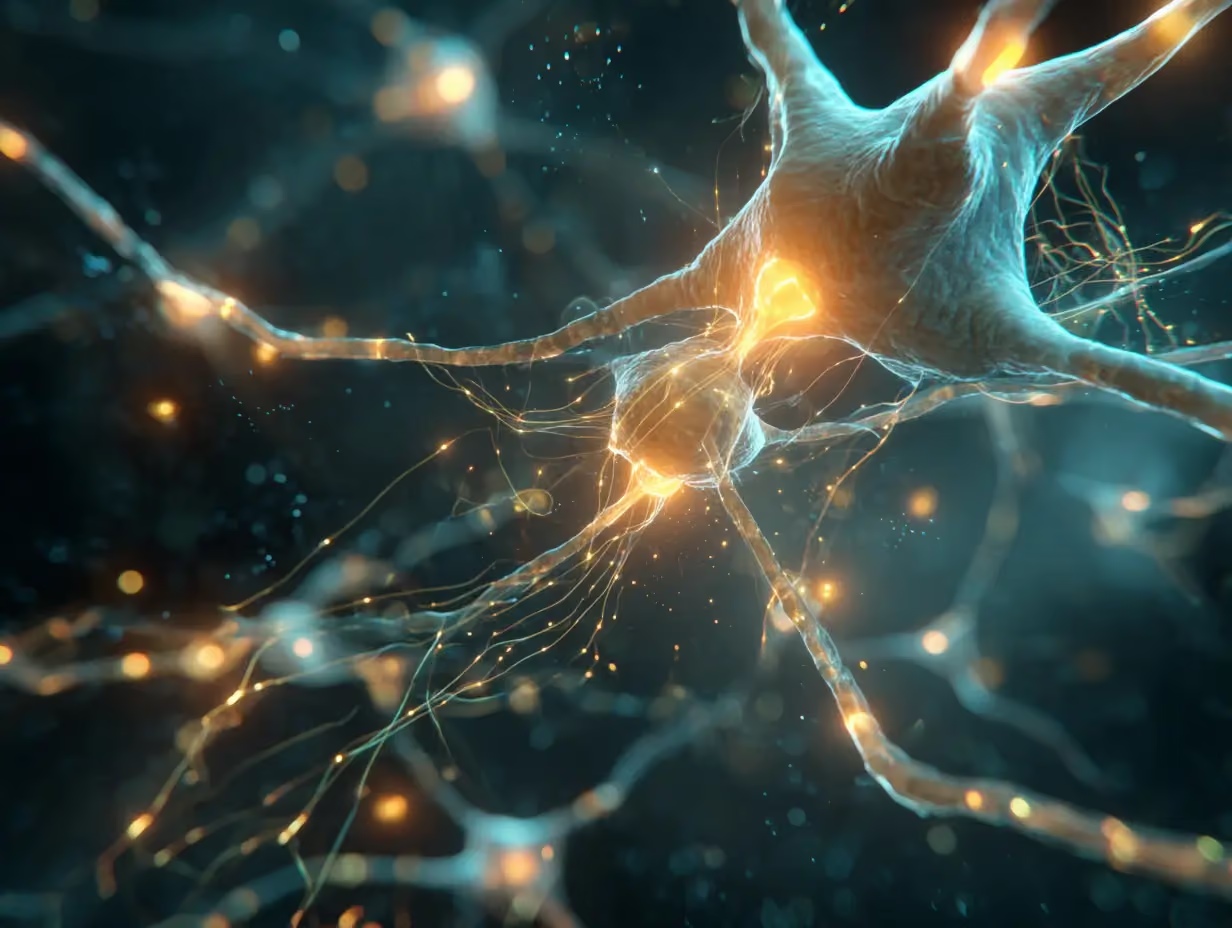
Every day, billions of people around the world take a powerful drug without realizing it. It doesn’t come in a prescription bottle or require a dealer. It’s in your coffee, tea, energy drink, soda, or even chocolate. That drug is caffeine, and while it's widely accepted and often overlooked, it’s actually the most commonly consumed recreational drug on Earth. More than just a quick pick-me-up, caffeine alters how your brain works, how you feel, and how you function. And it might be quietly rewiring your brain every single day.
Let’s break down what caffeine is really doing inside your body, and why it matters.
Caffeine Blocks Your Brain’s Tiredness Signal
Your brain uses a chemical called adenosine to track how long you've been awake. As the day goes on, adenosine builds up, binding to receptors in your brain and making you feel tired. It’s a natural system that tells your brain, “It’s time to rest.”
Caffeine works by blocking those receptors, specifically, the A1 and A2A adenosine receptors. It slips into those spots and takes over, but without activating them. That means adenosine can’t deliver its "time to sleep" message. The result? You stay awake and alert.
But your brain adjusts. If you regularly drink caffeine, your adenosine receptors upregulate, and become more numerous, especially the A1 receptors. Because there are more receptors, you start to need more caffeine to block them all, for the same effect. This is why tolerance builds. Meanwhile, A2A receptors remain stable, and easier to block, which shifts caffeine’s impact toward motivation and movement rather than just alertness.
The Crash: Adenosine Doesn’t Go Away
While caffeine blocks adenosine, it doesn’t stop your brain from making it. Adenosine keeps building in the background. When the caffeine wears off, all that pent-up adenosine floods your brain, and you crash. This "rebound fatigue" explains why many people feel groggy again in the afternoon or need a second cup to keep going.
More Than Wakefulness: Caffeine Supercharges Brain Activity
Blocking adenosine doesn't just prevent tiredness. It also removes some of the natural brakes on brain activity. One major pathway involves a molecule called cAMP, which helps regulate how excitable your brain cells are. Normally, adenosine increases cAMP to help the brain slow down and recover. But when caffeine blocks this process, the brakes come off.
At the same time, caffeine boosts glutamate, the brain’s primary excitatory neurotransmitter. Glutamate helps your brain fire faster and process information more efficiently. That’s why caffeine helps improve focus, attention, and cognitive performance, especially when you're tired.
The Brain Pushes Back: Endocannabinoids and Balance
But the brain doesn't like being overstimulated for too long. In response to this increased activity, it releases endocannabinoids, the natural chemicals that help calm down overactive neurons. These work like a cooling system for your brain.
The problem? If you drink caffeine daily, this balance gets harder to maintain. The brain starts working overtime to dampen the stimulation, which contributes to tolerance, dependence, and even mental fog when caffeine isn’t present. In a way, the more you use caffeine, the more your brain fights back.
Focus Amplified: Caffeine Unlocks Your Brain’s Gatekeeper
Caffeine also affects a part of your brain called the thalamus. Think of it as the gatekeeper of your senses. It decides what sensory information gets through to your conscious brain and helps keep everything in sync.
By blocking A2A receptors that normally dampen the thalamus, caffeine makes this gatekeeper more active. That means your brain can process more information, faster. You can filter out distractions more easily, stay focused longer, and react quicker. This is why caffeine improves performance on tasks that require alertness and vigilance.
Removing the Brakes on Motivation and Movement
The brain’s striatum, a key part of the reward and movement system, is also deeply affected by caffeine. It has two main pathways: one that encourages action (like stepping on the gas), and one that holds you back (like hitting the brakes). The braking system relies heavily on adenosine A2A receptors.
Caffeine blocks these receptors in the “braking” pathway, making it less active. At the same time, dopamine, the “feel good” neurotransmitter, gains more influence. This combination helps you feel more motivated, driven, and ready to act.
But too much caffeine? The brakes are too far off. That’s when you feel jittery, anxious, or overstimulated...a sign that the brain’s filters are overwhelmed.
How Long Does Caffeine Last?
Caffeine starts working within 30 to 60 minutes of consumption and sticks around for 3 to 7 hours, depending on your body’s metabolism.
Here’s a rough idea of how long caffeine from different sources stays in your system:
- Black tea (40–50 mg): 3–5 hours
- Coffee (80–100 mg): 4–6 hours
- Espresso (60–80 mg): 4–6 hours
- Energy drink (80–200 mg): 4–8 hours
- Pre-workout (150–400 mg): up to 8 hours
Let’s say you drink a 100mg cup of coffee at 7 AM. By 7 PM, you might still have 25mg in your system, enough to slightly disrupt your sleep. Drink another cup in the afternoon, and that leftover caffeine can stack up day after day, keeping your brain in a semi-stimulated state 24/7.
What Happens When You Stop?
Quitting caffeine after regular use can be rough. When you stop, your brain is suddenly hit with all that built-up adenosine, but your receptors are still numbed from chronic caffeine exposure. At the same time, A2A receptors (which regulate dopamine and motivation) are still sensitive, and they get overwhelmed.
This creates a double hit: You feel extremely tired, unmotivated, foggy, and sluggish, but also irritable, sensitive, shaky, and muscle tension (often causing things like headaches). It can take several days for your brain chemistry to rebalance and your sleep cycles to normalize.
Why This Matters for Healthcare Providers
Understanding the mechanisms behind caffeine’s effects is more than just academic; it’s clinically relevant. Caffeine is often treated like a harmless habit, but it’s a powerful neuromodulator that alters core brain systems. Recognizing how caffeine affects sleep, mood, attention, motivation, and neurochemistry helps healthcare providers:
- Explain symptoms like anxiety, brain fog, or fatigue that may be tied to overuse or withdrawal
- Leverage caffeine strategically in care plans, such as for patients with ADHD, concussion-related fatigue, or cognitive burnout
- Time dosing around treatments, work demands, or sleep issues
- Educate patients about tolerance, dependence, and the difference between short-term performance and long-term brain health
In short, caffeine isn’t just a drink. It’s a drug. One that most people use daily, without understanding how deeply it shapes their brain. As providers, understanding both the science and the behavior behind caffeine use helps us guide patients with clarity and confidence.
But caffeine’s effects go far deeper than blocking tiredness.
What happens when we trace its influence into the striatum, where adenosine and dopamine battle for behavioral control? How does it interfere with cAMP signaling, tipping the balance of excitation and inhibition in neurons? What role do thalamocortical projections play in sustained attention, and how does caffeine amplify or distort them? And what about acetylcholine, the neurotransmitter of focus, memory, and learning, which caffeine subtly modulates across the cortex and hippocampus?
These are the systems that don’t just regulate wakefulness. They shape human behavior, neurological health, and even neurodegeneration. Used wisely, caffeine may offer cognitive protection and therapeutic potential. Used carelessly, it may erode plasticity, sleep architecture, and long-term brain resilience.
Develop Your Clinical Expertise
If you’re ready to move beyond headlines and truly understand the neurochemical networks that shape clinical decisions. This is exactly the type of inquiry we explore in-depth at the Carrick Institute. Through our immersive education in functional neurology and brain-based care, you’ll learn to decode complex systems like the adenosinergic network, the cholinergic basal forebrain, and striatal-thalamocortical loops, not just to sound smart, but to make smarter decisions for your patients.
The science is deep. The stakes are real. And the learning never ends.
🔬 Ready to go beyond the buzz?
Discover how the Carrick Institute is training the next generation of brain-based clinicians.
These courses provider a Deeper Dive into this topic.
%
Off

Neurorehabilitation of the Basal Ganglia
Command basal ganglia neuroscience across movement, cognition, habit, and disease in this 25-credit course designed for advanced clinical practice.
$
/hr.
$
/hr.
$
/hr.
$
/hr.
$
/hr.
$
/hr.
|
hours
%
Off
Neurochemistry & The Endocrine System
Decode the neuroendocrine system and elevate your clinical reasoning across HPA, thyroid, gonadal, and metabolic axes in 15 CE credits.
$
/hr.
$
/hr.
$
/hr.
$
/hr.
$
/hr.
$
/hr.
|
hours
More Insights
.avif)
BTSP: The Discovery of Instantaneous Neuroplasticity
For a century, neuroscience taught that plasticity meant slow yielding under repeated pressure. A new discovery says otherwise. Behavioral timescale synaptic plasticity — BTSP — shows that the brain can rewire itself in a single moment when two specific signals converge in the right network. Here's the science, and why it offers a long-overdue explanation for what skilled functional neurology providers have been observing in the clinic for decades.
The NERD Model: Why Some Concussion Patients Get Stuck
Why don't some concussion patients get better? They’re literally stuck. The NERD model reveals how maladaptive neural loops trap recovery and how clinicians can break the cycle.

The New "Flexible Access" Policy: Access that Meets Your Needs and Budget
Carrick Institute's Flex Access policy delivers faster course completion, lower costs, and flexible learning that actually works. By replacing Unlimited Access with structured timeframes based on course length, scholars gain the motivation and accountability needed to finish courses while maintaining the freedom to extend or revisit content.
When a Concussion Unleashes Something Deeper
When a concussion doesn’t heal as expected, it may reveal something far deeper. This post explores how traumatic brain injury can unmask hidden tick-borne infections—like Lyme and its co‑infections—through shared pathways of neuroinflammation and immune dysfunction. For clinicians, it’s a call to look beyond “post-concussion syndrome” and recognize emerging research that links persistent symptoms, immune dysregulation, and overlooked infection.

Molecular Hydrogen: A Foundational Therapy for Neurology, Regeneration, and Integrative Clinical Practice
Molecular hydrogen (H₂) is emerging as a foundational therapy for integrative clinics. This small molecule crosses the blood-brain barrier, selectively neutralizes harmful free radicals, and supports mitochondrial function. Safe, inexpensive, and easy to implement, H₂ enhances outcomes for neurorehabilitation, chronic inflammation, and regenerative protocols. Learn how to integrate it into your practice.

What Healthcare Can Learn From Boy Scouts: An Opinion Piece
We believe that education should be democratized—not locked behind professional guilds or lifetime specialties. That's why we allow any licensed health care provider to take our programs.We may not be able to certify every provider to perform every procedure—regulatory and scope-of-practice rules exist for good reason—but we can provide the knowledge, skills, and frameworks to broaden their thinking and improve their care. When a physical therapist understands neurochemistry, or a medical doctor understands vestibular rehabilitation, patients win.
Diplomate vs. Fellowship in Functional Neurology: The Difference and Why It Matters
Diplomate or Fellow? One proves you’re qualified. The other proves you’re exceptional. In functional neurology and beyond, these two credentials are often confused—but understanding the difference can define your credibility, impact your scope, and elevate your career. This post breaks it down simply, clearly, and with legal clarity every healthcare professional should know.

Why Elite Healthcare Providers Are Mastering Integrative Health
The future belongs to providers who refuse to be limited by traditional boundaries. Master the integration, lead the evolution.
Functional Neurology: The Original Blueprint for Understanding the Dynamic Brain
Discover how functional neurology is transforming patient care worldwide. This post explores the origins of the movement pioneered by the Carrick Institute, its groundbreaking network model of brain function, and how clinicians use these principles to help complex cases that defy conventional treatments. From recalibrating sensory inputs to mastering dynamic brain interventions, learn why thousands of healthcare providers have embraced functional neurology to deliver life-changing outcomes.

Functional Neurology: Rethinking How We Approach the Nervous System
Functional neurology is redefining how clinicians approach neurological dysfunction—seeing the nervous system as a dynamic, adaptable network instead of a static circuit. This article explores its origins, the network model that maps brain function hierarchies, and how targeted interventions recalibrate maladaptive patterns. Learn how this revolutionary systems-based approach helps patients with persistent symptoms and why it’s becoming an essential paradigm for healthcare providers worldwide.
Ready to bring Carrick Institute to your event?
Use the form below to tell us about your organization, audience, and goals. Our team will follow up with availability and speaker recommendations.
Get new articles delivered to your inbox
Stay updated on the latest in clinical neuroscience education—new articles, course releases, research spotlights, and more.